
5 Problems Church Live Streaming Solves (and 3 It Doesn’t)

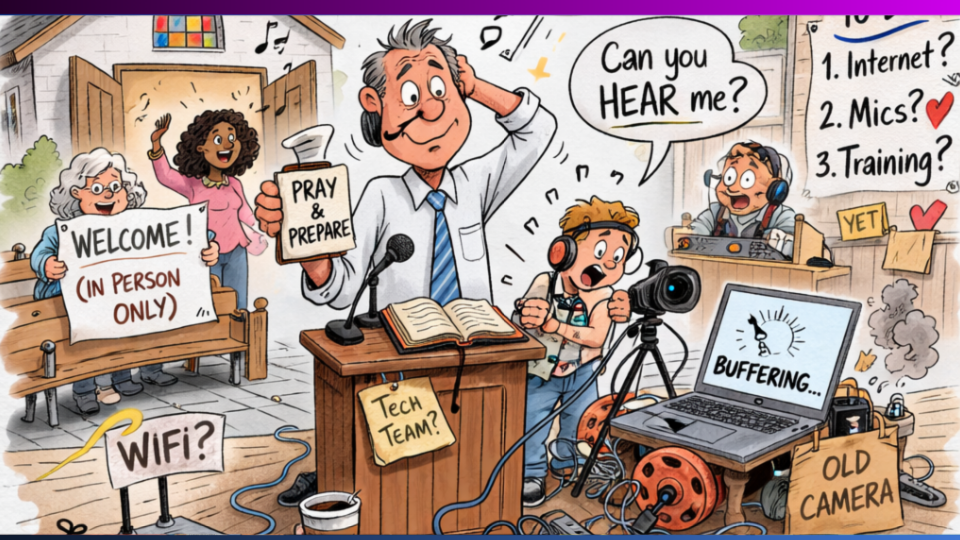
Church live streaming is the real-time transmission of a worship service over the internet, enabling remote viewers to watch and listen as the service occurs. Adoption of live streaming among U.S. churches accelerated during the COVID-19 pandemic, and post-pandemic data indicates sustained demand. According to Pew Research Center (January 2024), 16% of U.S. adults who attend religious services now do so primarily online.
Live streaming addresses specific, well-documented operational and pastoral challenges. It also has clear limitations. This analysis identifies five problems that church live streaming solves and three that it does not.
Problem 1: Physical Accessibility for Homebound and Disabled Members
Congregations include members who cannot attend services due to physical disability, chronic illness, post-surgical recovery, or age-related mobility limitations. The U.S. Census Bureau (2023) reports that approximately 13.4% of the civilian noninstitutionalized population has a disability, and that figure rises to approximately 40% among adults aged 65 and older.
Live streaming delivers the worship service directly to members in hospitals, assisted living facilities, and private homes. Among online-only church attendees, 36% cited health problems or disabilities as their primary reason for not attending in person (Pew Research Center, January 2024). A basic streaming setup, such as the Budget Church Live Streaming Kit, enables congregations to serve these members without requiring specialized technical expertise.
Prior to live streaming, churches relied on audio recordings, printed sermon notes, or pastoral home visits to reach homebound members. Each of those methods introduced delays of hours or days. Live streaming eliminates that delay entirely, providing simultaneous participation in real time.
Problem 2: Geographic Reach Beyond Local Boundaries
The average U.S. church has 65 regular in-person attendees, according to the Hartford Institute for Religion Research (2023). That number represents only the individuals within physical travel distance of the facility. Live streaming removes geographic constraints from attendance.
Three recurring population segments benefit from geographic reach expansion. Military families stationed at distant bases maintain connection to their home congregation. College students attending universities in other states access familiar worship. Seasonal residents who split time between two locations participate year-round without interruption.
Barna Group data (2024) indicates that 35% of practicing Christians watch a church service online at least once per month, and approximately 18% of those viewers watch a church in a different city or state from where they reside. Multi-site church models also depend on streaming infrastructure to extend a single teaching pastor across multiple campuses.
Problem 3: Visitor Preview and First-Impression Management
First-time visitors increasingly evaluate a church online before attending in person. LifeWay Research (2023) found that 77% of first-time church visitors researched a congregation online before their initial visit. Of those, 54% reported that watching a recorded or live service influenced their decision to attend.
A live stream functions as a continuous open house. Prospective visitors can evaluate preaching style, worship format, congregational demographics, music selection, and facility quality at any time without social pressure or commitment. Grey Matter Research (2022) found that 63% of churchgoers said the quality of online content influenced their perception of a church’s credibility.
Production quality directly affects this first impression. A 2-Camera Live Streaming Kit provides multiple camera angles that create a more polished and engaging broadcast compared to a single static shot, which improves viewer retention and visitor conversion.
Problem 4: Content Archiving and Repurposing
A live stream that is simultaneously recorded creates a permanent digital archive of every service. That archive serves multiple downstream functions: sermon clip creation for social media, audio extraction for podcast distribution, midweek small group discussion material, and training content for ministry leaders.
Churches that maintain accessible sermon archives report increased midweek engagement from members who review content between Sundays (Pushpay Church Communications Survey, 2023). Archived video also supports discipleship programs that assign past sermons as study material.
Without live streaming infrastructure, archiving requires a separate recording workflow with dedicated equipment and additional volunteer labor. Streaming systems consolidate the recording and distribution process into a single operation. Hardware-based encoders like the ATEM Mini Pro 1-Camera Streaming Kit record locally while simultaneously streaming, ensuring archival capture occurs automatically without additional steps.
Problem 5: Worship Continuity During Disruptions
Facilities become unavailable due to weather events, building system failures, public health emergencies, and scheduled maintenance. Churches without streaming infrastructure have no mechanism to deliver services during these interruptions.
The COVID-19 pandemic provided the most visible demonstration of this vulnerability. Pew Research Center (March 2021) reported that 40% of U.S. adults who typically attended religious services at least monthly watched services online during pandemic closures. Churches that already had streaming systems transitioned to online-only delivery within hours. Churches without that infrastructure experienced attendance declines of 30-50% with no digital alternative (Barna Group, State of the Church, 2021).
Disruption preparedness does not require a large investment. Even a single-camera streaming setup provides a functional fallback. Portable all-in-one units such as the YoloBox Pro consolidate encoding, switching, recording, and monitoring into a single device, enabling rapid deployment from any location with an internet connection.
Problem 6 (That Streaming Does Not Solve): Community Building and Relational Connection
Live streaming transmits audio and video. It does not transmit physical presence, shared meals, handshakes, spontaneous hallway conversations, or the relational dynamics that constitute church community.
Barna Group (2024) found that 62% of online-only church attendees reported feeling “somewhat” or “not at all” connected to their church community. Among in-person attendees, that figure was 23%. The 39-percentage-point gap quantifies the relational cost of remote-only participation.
Chat features and comment sections during live streams provide a limited form of interaction. That interaction remains qualitatively different from in-person fellowship. Churches that treat live streaming as a full replacement for physical gathering risk cultivating a congregation of passive viewers rather than relationally connected participants.
Problem 7 (That Streaming Does Not Solve): Volunteer Burnout and Increased Operational Load
Live streaming does not reduce volunteer requirements. It adds new roles to the existing volunteer structure: camera operators, audio engineers, stream monitors, graphics operators, and social media moderators during broadcasts.
Church Answers (2023) reported that 78% of churches with active streaming programs rely on the same two to five volunteers to manage all technical production duties each week. These technical demands exist in addition to pre-existing volunteer needs such as greeting, childcare, and music. The compounding effect accelerates burnout among the small number of technically skilled members.
Mitigation strategies include investing in equipment that reduces operator count. PTZ (pan-tilt-zoom) cameras with preset positions, such as the PTZOptics Move 4K 30X, allow a single operator to control multiple camera angles remotely. Automated systems reduce the minimum volunteer requirement but do not eliminate it entirely.
Problem 8 (That Streaming Does Not Solve): Depth of Spiritual Engagement
Online viewing environments introduce variables that reduce spiritual engagement. Multi-screen households, notification alerts, household interruptions, and the absence of a dedicated worship space all compete for viewer attention.
LifeWay Research (2023) documented lower participation in worship activities among online viewers compared to in-person attendees across all measured categories: singing, prayer, communion, and financial giving. Barna Group (2024) found that online-only attendees were 40% less likely to engage in personal prayer, Bible reading, or financial giving compared to in-person attendees.
Certain elements of Christian worship are inherently physical. Communion, baptism, the laying on of hands, and corporate singing involve bodily participation that a screen cannot replicate. Live streaming provides access to the content of a worship service but not the full embodied experience of corporate worship.
Summary
The following table classifies the eight problems addressed in this analysis by whether live streaming provides a solution.
| Problem | Streaming Solves? | Key Data Point |
|---|---|---|
| Physical accessibility for homebound/disabled members | Yes | 36% of online-only attendees cite health/disability (Pew, 2024) |
| Geographic reach beyond local boundaries | Yes | 18% of online viewers watch a church in a different state (Barna, 2024) |
| Visitor preview and first impressions | Yes | 77% of first-time visitors research online first (LifeWay, 2023) |
| Content archiving and repurposing | Yes | Streaming systems record and distribute in a single operation |
| Worship continuity during disruptions | Yes | 40% of regular attendees watched online during COVID (Pew, 2021) |
| Community building and relational connection | No | 62% of online-only attendees feel disconnected (Barna, 2024) |
| Volunteer burnout and operational load | No | 78% of streaming churches rely on 2-5 repeat volunteers (Church Answers, 2023) |
| Depth of spiritual engagement | No | Online attendees 40% less likely to engage in prayer/giving (Barna, 2024) |
Live streaming is a distribution tool. It solves distribution problems: getting worship content to people who cannot or have not yet attended in person. It does not solve formation problems: building community, sustaining volunteer health, or deepening spiritual engagement. Churches that deploy streaming infrastructure with accurate expectations of its capabilities and limitations position themselves to serve both in-person and remote congregants effectively.