
One-camera PTZ kit vs. a camcorder in the back of the room

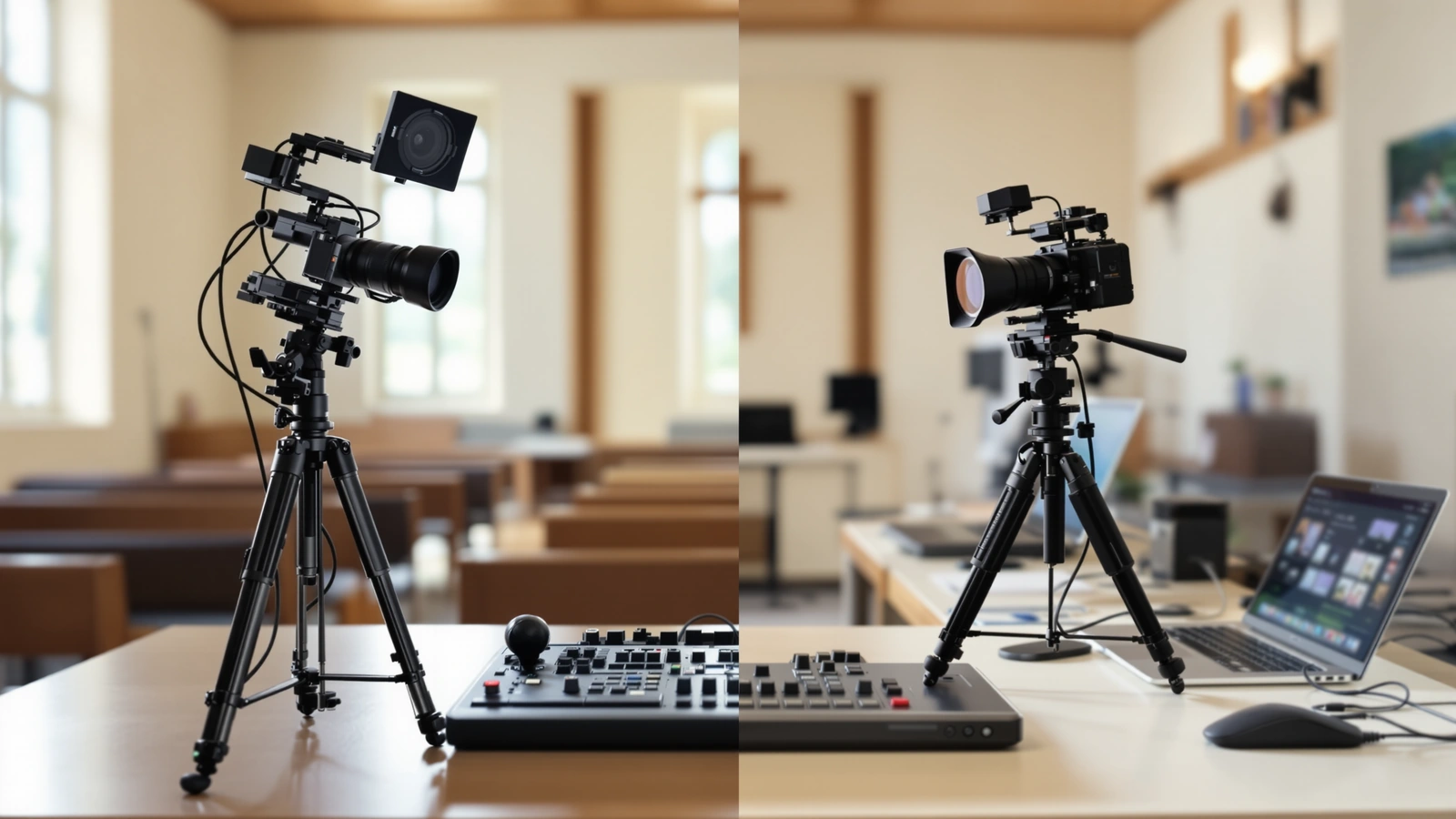
Plenty of churches already own a camcorder, and the instinct to put it on a tripod at the back of the room and start there is a reasonable one. A camcorder you already have is a real asset, and for some rooms and some volunteers it is a sensible way to get online. The question worth asking is not which option is better in the abstract, but which one fits the way your church actually runs a Sunday: who operates it, where it has to sit, how far it is from the platform, and what you want the viewer at home to be able to see and follow.
We sell both kinds of system, the camcorder-based kit and the PTZ kit, because each is the right answer for a different room. A camcorder at the back of the room and a one-camera PTZ setup solve the same core job of getting a single clean angle into a stream, and they differ mainly in how that angle gets framed, who has to be standing there to frame it, and how the shot changes during the service. Walking through those differences honestly is the fastest way to tell which one belongs in your room.
What a camcorder in the back of the room does well
A camcorder set up at the back of the sanctuary is a familiar, self-contained way to capture a service, and that familiarity is worth something. Many church volunteers have used a camcorder before, the controls make intuitive sense, and a good one with optical zoom and a decent sensor can produce a pleasing image when the room is lit well and the camera is placed at a sensible distance. For a church that primarily wants a faithful record of the service from one fixed vantage, and that has someone comfortable framing it, a camcorder kit can do the job.
The camcorder also carries some genuine advantages tied to its design. It runs on its own battery or power, it records to its own media as a built-in backup, and it can be picked up and carried to an offsite event, a baptism at the lake, or a midweek gathering. If your church values a camera that doubles as a portable recorder for non-live use, that flexibility is real. Our ATEM Mini Pro 1-camera streaming kit pairs a camcorder-style camera with the same hardware switcher we use across our PTZ kits, so the streaming side stays just as simple either way.
Where a camcorder fits best is a room where the camera can sit reasonably close to the platform, where a volunteer is available to operate it, and where the shot does not need to change much during the service. In that setting the camcorder is not a compromise; it is a clean match for the need. The honest limit is that a camcorder is most at home when someone is behind it, because its strengths are built around a person framing and adjusting the shot in the moment.
What a one-camera PTZ kit changes about the job
A PTZ camera approaches the same single-angle job from a different direction, which is that it is built to be controlled remotely and to move on command without anyone standing at the camera. PTZ stands for pan, tilt, and zoom, and all three are motorized, so the camera can sit mounted on a back wall or a balcony rail and still pan to the worship leader, tilt to the choir, and zoom tight on the pastor, all driven from a control surface, presets, or auto-tracking. That changes who has to be present and what one angle can do over the course of a service.
The practical payoff shows up most in churches with thin volunteer rosters. A PTZ camera mounted out of the way runs without a person posted at the tripod, which frees your one available volunteer to mind the switcher and the stream rather than the camera. With a few presets saved for the wide shot, the pulpit, and the worship leader, recalling a framing is a single button press, and the Move SE 1-camera kit with the ATEM Mini Pro adds built-in auto-tracking so the camera can follow a moving speaker on its own. We dig into why this suits churches in our piece on why PTZ cameras fit churches running both in-person and online services.
Reach is the other place a PTZ kit shows its design intent, because it is meant to live far from the platform. The Move SE comes in 12x, 20x, and 30x optical zoom and, according to PTZOptics’ product page, can hold a tight, clean shot from well across a large room and even track a subject from a significant distance. That makes it a strong match for a balcony mount or a long sanctuary where the only practical camera position is sixty or eighty feet back. A camcorder can be placed at that distance too, but a person generally needs to be there to work it, whereas the PTZ is designed to be driven from elsewhere.
Image quality and the room you are filming in
Both a quality camcorder and a quality PTZ camera can produce a clean image, so the more useful comparison is how each handles the specific conditions of a sanctuary. Churches are usually dimmer than they feel, and the platform lighting is often uneven, which means a camera’s sensor and its optical zoom matter more than its headline resolution. The Move SE uses a Sony CMOS sensor and real optical glass, so it holds up in the low, mixed light most sanctuaries have, and the same is true of a camcorder built around a good sensor.
The trap to avoid with either type of camera is leaning on digital zoom to reach a distant platform. Optical zoom moves real glass and keeps the picture sharp, while digital zoom enlarges pixels and softens the image, so a camera with the right optical reach for your room will always look better than one straining past its optical limit. This is the same reasoning whether you are choosing a camcorder or a PTZ, and we lay out the broader camera decision in our roundup of the best live stream cameras for churches.
Framing is the place the two cameras genuinely diverge on image, and it is worth being concrete about it. A camcorder on a tripod holds whatever shot the operator sets, and changing it means a person physically zooming and re-aiming, which reads on camera unless they are practiced. A PTZ camera changes framing by recalling a saved preset or letting auto-tracking adjust, so the shot can shift smoothly between a wide and a closeup without a hand on the camera. Neither approach is wrong, but if you want the framing to change during a service and you do not have someone to make those moves cleanly, the PTZ is doing a job the camcorder was not designed for.
Streaming and recording look the same from either starting point in our kits, which is worth knowing because it takes the production tool out of the comparison. Both the camcorder kit and the PTZ kit feed a Blackmagic ATEM Mini Pro, which handles hardware streaming to YouTube or Facebook, recording to a USB drive, audio mixing, and a multiview, per Blackmagic’s product page. So the choice between camcorder and PTZ is really about the camera and how it gets operated, not about how the stream itself goes out.
Matching the camera to your room and your volunteers
The cleanest way to decide is to picture your actual Sunday and ask who is standing where. If you have a volunteer who enjoys running a camera, the camera can sit fairly close to the platform, and you mostly want a steady single angle, a camcorder kit fits that picture well and uses skills your team may already have. If your camera has to live far from the stage, or you cannot reliably staff a camera position every week, or you want the shot to change during the service without a person making each move, the PTZ kit is built for exactly that situation.
Budget tends to follow that same logic rather than driving it. A capable PTZ camera usually costs more than a basic camcorder, and that difference is paying for the motors, the optical reach, the remote control, and the auto-tracking that let one angle do more with fewer hands. Whether that is worth it depends entirely on your room and your roster, which is the right way to think about it. We put both options inside the larger budget picture in our guide to how much a church livestream setup costs in 2026.
It also helps to think a year ahead. A camcorder kit serves a church that wants a portable, operator-driven camera and a faithful single angle, while a PTZ kit serves a church that wants a mounted, remotely controlled camera that can grow into a multi-angle setup later on the same switcher. Neither path is a wrong turn; they simply lead to different rooms. The most expensive choice is buying for a workflow your volunteers cannot sustain, so let the people and the room decide.
If the remote control, the long optical reach, and the hands-off operation of a PTZ camera match how your church runs Sunday morning, the Move SE 1-camera PTZ streaming kit with the ATEM Mini Pro is the build we point most churches toward first, and we are glad to talk through your room before you decide between it and a camcorder kit.