
Blog
What Happens When You Launch a Livestream Without a Plan

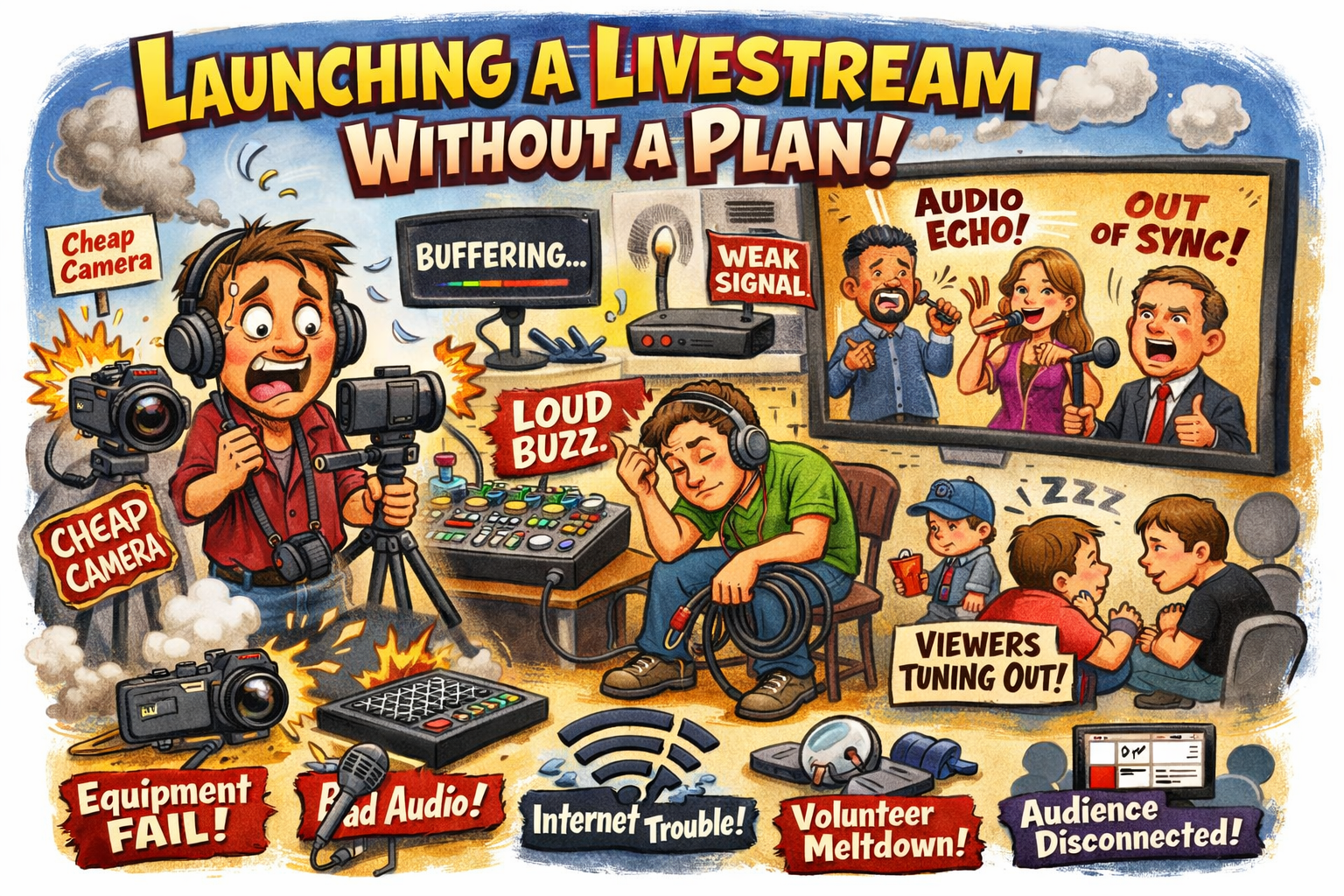
An unplanned livestream launch refers to the deployment of live video broadcasting for a worship service without prior assessment of equipment requirements, internet infrastructure, volunteer staffing, audio engineering, or audience engagement strategy. This pattern became widespread during the COVID-19 pandemic, when 96% of U.S. Protestant churches began streaming worship services, up from approximately 50% pre-pandemic (LifeWay Research, 2021). The rapid adoption rate indicates that a substantial portion of churches initiated streaming reactively, without structured preparation.
The consequences of an unplanned launch fall into five categories: equipment failure, audio degradation, internet instability, volunteer attrition, and audience disengagement. Each category produces distinct technical and organizational outcomes that compound over time. Churches that address these categories before the first broadcast experience 60% fewer technical failures than those that do not (Bitcentral/Streaming Media, 2022).
Classification of Failure Modes
Equipment-Related Failures
Equipment-related failures occur when churches attempt to livestream using consumer devices not designed for sustained live broadcasting. Smartphones, laptop webcams, and consumer-grade camcorders lack the sensor size, manual exposure controls, and sustained thermal performance required for 60- to 90-minute worship service broadcasts. The most common equipment-related complaints from online viewers include incorrect aspect ratios, unstable framing, and washed-out or excessively dark video (Bitcentral/Streaming Media, 2022).
Thirty-one percent of churches that stream report recurring aspect ratio or resolution errors, and 38% report persistent lighting-related video quality issues (Bitcentral/Streaming Media, 2022). These failures result from the absence of dedicated cameras with manual white balance, iris control, and fixed mounting positions. Consumer devices rely on automatic exposure algorithms that continuously adjust to changing stage lighting, producing visible flickering and color shifts in the output stream.
Audio Degradation
Audio quality is the single most consequential technical factor in livestream viewer retention. Online viewers tolerate mediocre video quality but abandon streams with poor audio within 30 to 90 seconds (Church Answers, 2022). Common audio failures in unplanned church streams include room echo from uncontrolled acoustics, distortion from overdriven microphone inputs, inconsistent volume levels between speakers and musicians, and audible background noise from HVAC systems or congregation movement.
Forty-seven percent of churches report recurring audio-video synchronization issues during live broadcasts (Bitcentral/Streaming Media, 2022). Audio desynchronization typically results from mismatched processing chains, where the video path and audio path introduce different amounts of latency. Purpose-built streaming hardware, such as dedicated video switchers with integrated audio mixers, eliminates this category of failure by processing audio and video through a synchronized pipeline.
Internet Infrastructure Instability
Livestreaming requires sustained, symmetrical upload bandwidth. A single 1080p stream at standard bitrates requires 4 to 8 Mbps of continuous upload throughput. Multi-camera productions with higher quality encoding settings require proportionally more. Thirty-five percent of churches that stream report recurring bandwidth insufficiency (Bitcentral/Streaming Media, 2022), and 43% report dropped frames or buffering visible to end viewers.
Churches that launch without conducting a bandwidth assessment frequently discover mid-broadcast that their internet connection cannot sustain the required throughput. Shared networks, where the streaming system competes with congregational Wi-Fi usage, amplify this problem. A dedicated, wired Ethernet connection reserved exclusively for the streaming encoder is a baseline infrastructure requirement. Churches that performed bandwidth testing and equipment verification before their first broadcast experienced significantly fewer stream interruptions than those that did not.
Volunteer Attrition and Burnout
Churches that launch streaming without a staffing plan typically rely on one or two technically inclined members to operate all streaming equipment every week. The National Association of Evangelicals reported in 2022 that churches following this model experienced volunteer burnout within three to six months. A Christianity Today survey in 2021 found that 42% of church tech volunteers reported feeling overwhelmed by weekly streaming demands; among those, 68% said their church provided no formal training for the role.
Volunteer burnout produces a cascading failure. When the primary volunteer becomes unavailable due to illness, relocation, or exhaustion, no trained replacement exists. The stream either ceases entirely or is operated by an untrained substitute, resulting in degraded quality. A sustainable volunteer model requires a minimum rotation of three trained operators, a written standard operating procedure, and a structured training program. Pre-configured streaming systems that minimize the number of operational decisions reduce the training burden and expand the pool of eligible volunteers.
Audience Disengagement
The absence of an online engagement strategy causes viewer retention to decline after the initial launch period. Churches offering livestreams with dedicated engagement tactics — including live chat moderation, online welcome teams, follow-up communication systems, and integrated digital giving — saw 12% higher overall engagement than churches without such strategies (Pushpay/Church Community Builder, 2023). Barna Group data from 2021 indicated that churches with inconsistent streaming schedules experienced 40 to 60% viewer drop-off within the first three months.
Treating a livestream as a passive broadcast of the in-room experience, rather than an intentional online worship experience, is the most common strategic failure. Online viewers have different needs than in-person attendees: they lack the social reinforcement of physical presence, they face competing digital distractions, and they have no natural pathway to connect with the church community unless one is deliberately provided. Churches that do not design for these differences lose the majority of initial online viewers within weeks.
Technical Requirements for a Planned Launch
A planned livestream launch addresses each failure category through specific technical and organizational preparations. The following subsections outline the baseline requirements for video, audio, encoding, networking, and volunteer operations.
Video Acquisition
A minimum viable church streaming setup requires at least one dedicated camera with manual exposure controls, a fixed mounting system (tripod or wall mount), and an HDMI or SDI output for connection to a video switcher or encoder. A single 4K camera with virtual multi-angle capability, such as those included in a 1-camera streaming kit, provides wide-shot and close-up framing from a single physical camera position. This configuration eliminates the need for a camera operator while still producing multiple visual perspectives.
Multi-camera configurations using two or more cameras with a hardware video switcher provide distinct optical angles and enable live switching between shots. Hardware switchers with integrated streaming encoders, such as the Blackmagic ATEM Mini Pro series, process video switching and stream encoding in a single device, reducing system complexity and points of failure.
Audio Capture
The audio signal chain requires a feed from the house sound console. A direct audio feed bypasses room acoustics and captures a controlled mix of speech and music. The feed connects to the streaming encoder or video switcher via a 3.5mm, XLR, or embedded HDMI audio input, depending on the equipment configuration. Churches without a sound console require at minimum a directional microphone positioned to reject ambient noise.
Encoding and Delivery
A hardware encoder or a dedicated streaming computer converts the video and audio input into a compressed stream for delivery to platforms such as YouTube Live, Facebook Live, or a church website player. Hardware encoders offer lower latency and higher reliability than software-based encoding on general-purpose computers. The encoder connects to the internet via wired Ethernet, not Wi-Fi, to ensure stable throughput.
Network Infrastructure
The streaming system requires a dedicated internet connection or a VLAN (virtual local area network)-segmented network port that isolates streaming traffic from congregational Wi-Fi. A pre-launch bandwidth test should confirm that sustained upload throughput exceeds the target stream bitrate by at least 50% to accommodate network variability. For a 1080p stream at 6 Mbps, the connection should sustain at least 9 Mbps of upload bandwidth consistently.
Volunteer Operations
A volunteer operations plan includes a written checklist for pre-service setup, a mid-service monitoring protocol, and a post-service shutdown procedure. A minimum of three trained volunteers in a rotation prevents burnout and ensures coverage during absences. Each volunteer should complete at least two supervised practice sessions before operating independently.
Product Integration
Pre-assembled and pre-tested streaming kits reduce the technical knowledge required for a successful launch. These kits address the equipment selection, compatibility verification, and configuration steps that cause the majority of unplanned-launch failures.
The Budget Church Live Streaming Kit provides an entry-level hardware configuration that replaces smartphone-based setups with dedicated streaming components. For churches requiring multiple camera angles, the 2-Camera Live Streaming Kit includes dual 4K cameras with a hardware switcher, pre-tested for compatibility and configured for immediate deployment. The ATEM Mini Pro 1-Camera Streaming Kit combines a Blackmagic ATEM Mini Pro switcher with a single camera in a configuration that supports direct-to-platform streaming without a computer.
For churches seeking an all-in-one solution with minimal operational complexity, the Yolobox Live Streaming Kit integrates encoding, switching, recording, and monitoring into a single portable device. Churches requiring PTZ (pan-tilt-zoom) camera capabilities with remote control operation can deploy the PTZOptics Move 4K 30X camera for intelligent tracking and 30x optical zoom from a fixed installation point.
All pre-assembled kits eliminate the equipment compatibility failures, cable mismatch issues, and configuration errors that account for the majority of first-broadcast technical problems in unplanned deployments. Pre-testing and pre-configuration at the point of assembly mean that the receiving church can deploy the system without troubleshooting component interoperability.