
Blog
Why Most Churches Regret Their First Livestream Setup

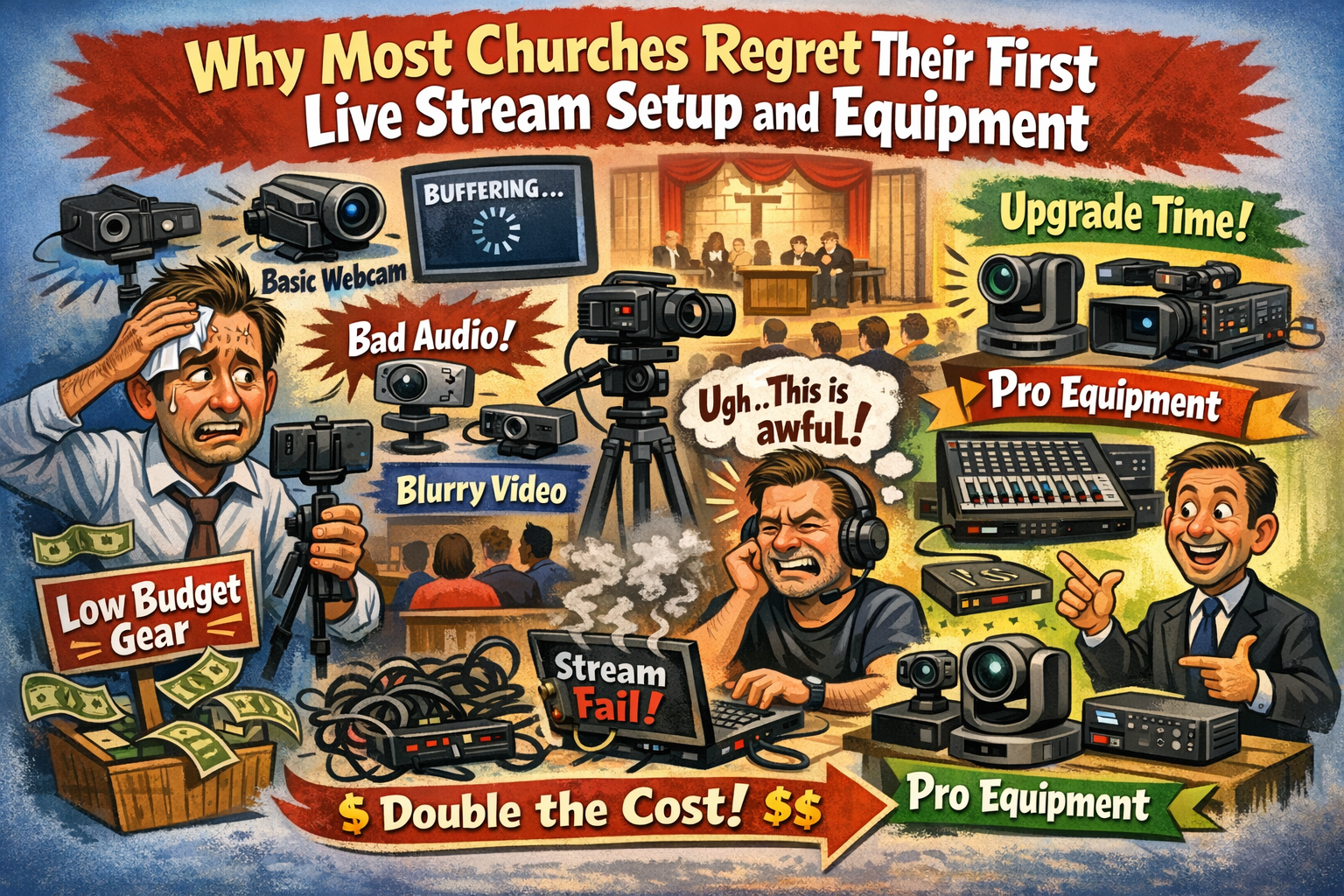
First-generation church livestreaming equipment refers to the initial hardware and software configuration a congregation deploys for real-time broadcast of worship services over the internet. In the majority of cases documented between 2020 and 2023, this first configuration consisted of consumer-grade components — smartphones, webcams, or entry-level camcorders — selected under time pressure during the COVID-19 pandemic. The term “first-generation” distinguishes this initial deployment from subsequent equipment upgrades that most churches undertake within 12 to 18 months of their first broadcast.
Scale of Rapid Adoption and Reactive Purchasing
LifeWay Research reported in 2021 that 96% of surveyed pastors said their church had streamed at least one worship service in the prior year, up from approximately 50% before the pandemic (LifeWay Research, 2021). This near-total adoption occurred within a compressed timeline of weeks, not months. Most churches made purchasing decisions without conducting equipment evaluations, consulting technical advisors, or testing configurations in their specific venues.
BoxCast surveyed more than 1,500 churches in 2022 and found that 62% had replaced or significantly upgraded their original streaming setup within 18 months of launch (BoxCast, 2022). ACS Technologies reported in its 2022 Church Technology Survey that 58% of churches spending under $1,000 on initial streaming equipment expressed significant regret over those purchases within the first year (ACS Technologies, 2022).
Classification of Common First-Setup Mistakes
The equipment failures that drive regret fall into five documented categories: camera limitations, audio deficiencies, internet infrastructure gaps, encoding reliability problems, and operational complexity. Each category represents a distinct failure mode with specific technical causes.
Camera Limitations: The Single Static Shot Problem
The most frequently reported visual deficiency is reliance on a single camera producing one static wide-angle shot from the back of the sanctuary. This configuration captures the full stage but provides no visual variety. Online viewers accustomed to broadcast television expect camera angle changes every 5 to 15 seconds. A fixed wide shot produces measurable viewer fatigue and higher abandonment rates during longer services.
Smartphone-based setups introduce additional problems. Battery depletion during 60- to 90-minute services causes mid-stream failures. Built-in smartphone microphones capture ambient room noise instead of direct audio. Digital zoom — the only zoom type available on most smartphones — degrades image resolution proportionally to magnification level. Consumer camcorders present a related issue: many lack clean HDMI output, which prevents direct video feed to a streaming encoder without on-screen display overlays.
Churches in medium-to-large sanctuaries require 20x to 30x optical zoom to achieve usable closeup shots from available camera mounting positions. PTZ (pan-tilt-zoom) cameras, such as the PTZOptics Move 4K with 30x optical zoom, provide this capability while allowing remote operation from a single control station. Remote operation reduces the number of required camera operators from one per camera to one operator managing multiple cameras.
Audio Deficiencies: The Primary Cause of Viewer Abandonment
Audio quality is the single most consequential technical factor in online viewer retention. A 2022 Church Production magazine reader survey found that 78% of responding churches identified audio as their most significant initial livestream quality problem (Church Production, 2022). Online viewers tolerate imperfect video more readily than poor audio. Muffled speech, room echo, feedback, and inconsistent volume levels cause viewers to stop watching within minutes.
The root cause in most cases is reliance on camera-mounted or on-board microphones. These microphones are omnidirectional consumer devices positioned 30 to 100 feet from the sound source. They capture room reverberation, HVAC noise, congregation movement, and ambient sound rather than isolated direct audio from the speaker or worship team.
The standard solution is a direct audio feed from the sanctuary sound board to the streaming encoder. This feed delivers the same processed, equalized, and mixed audio signal sent to the in-room speaker system. Ideally, a separate submix optimized for the stream — with different levels for speech, music, and ambient congregation sound — produces the best results. Churches that fail to establish this direct audio connection at initial setup consistently report the highest dissatisfaction with their first livestream deployment.
Internet Infrastructure: Shared Networks and Insufficient Bandwidth
Streaming video at 1080p resolution and 30 frames per second requires a sustained upload speed of 6 to 10 Mbps. Streaming at 4K resolution requires 20 Mbps or more. Many churches attempted initial streams over shared Wi-Fi networks simultaneously used by congregation members, staff devices, and facility systems. This shared usage creates bandwidth competition, packet loss, and stream interruptions.
Wi-Fi introduces additional instability compared to wired Ethernet connections. Signal interference from building materials, competing wireless devices, and distance from the access point causes latency spikes and dropped packets. Consumer-grade routers lack Quality of Service (QoS) traffic prioritization, meaning streaming data receives no preferential treatment over other network traffic.
A dedicated wired Ethernet connection from the streaming encoder to the network router, on an internet connection reserved for streaming use, eliminates most reliability problems. Churches that fail to establish this dedicated infrastructure at the outset experience recurring stream dropouts that erode viewer trust and attendance.
Encoding Reliability: Software Versus Hardware
Encoding is the process of compressing raw video and audio data into a streamable format (typically H.264 or H.265) and transmitting it to a streaming platform. Software encoding — using applications such as OBS Studio running on a general-purpose laptop or desktop computer — is the lowest-cost approach but introduces multiple failure points. Operating system updates, background processes, thermal throttling, and insufficient processing power cause frame drops, encoding lag, and application crashes.
Hardware encoders perform encoding on dedicated processors designed specifically for real-time video compression. These devices operate independently of general-purpose computer operating systems. Resi Media reported that churches using software-only encoding experienced stream interruptions approximately four times more frequently than those using dedicated hardware encoding solutions (Resi Media, 2022). Hardware-based systems such as the Blackmagic ATEM Mini Pro series integrate encoding with video switching, reducing component count and connection points. A purpose-built ATEM Mini Pro streaming kit consolidates switching, encoding, and streaming into a tested hardware workflow that does not depend on a general-purpose computer for core encoding functions.
Operational Complexity and Volunteer Sustainability
Technical capability of equipment is irrelevant if volunteers cannot operate it consistently. Churches that assemble streaming systems from individually purchased components — separate cameras, capture cards, switchers, encoding software, and audio interfaces from different manufacturers — create complex workflows requiring significant technical knowledge. When the one or two technically skilled volunteers who configured the system are unavailable, stream quality degrades or the stream does not occur.
BoxCast’s 2022 survey identified “difficulty of operation by volunteers” as a factor in 24% of first-setup replacements (BoxCast, 2022). The operational sustainability of a streaming system depends on standardized procedures, minimal required steps, and equipment that non-technical volunteers can operate after basic training. Systems with excessive complexity lead to volunteer burnout and inconsistent week-to-week production quality.
The Double-Purchase Pattern
The most financially consequential regret pattern follows a predictable sequence. A church purchases inexpensive consumer equipment, experiences poor results, and then purchases prosumer or professional equipment to replace it. The total expenditure exceeds what a single appropriate purchase would have cost.
ACS Technologies data quantifies this pattern. Churches that spent $2,000 to $5,000 on initial streaming setup reported 67% satisfaction rates. Churches that spent $5,000 to $15,000 reported 82% satisfaction. Churches that spent under $1,000 initially and then upgraded reported lower cumulative satisfaction despite higher total spending over time (ACS Technologies, 2022). The initial under-investment produced months of poor-quality streams that damaged the congregation’s perception of livestreaming before the upgraded equipment could reverse that impression.
Pre-Configured Systems Versus Component Assembly
Pre-configured streaming kits — systems in which cameras, switchers, encoders, cables, and mounting hardware are selected for compatibility, assembled, and tested as a unit before delivery — address multiple first-setup failure modes simultaneously. Compatibility between components is verified by the supplier rather than by the church’s volunteer team. Cable types and lengths are matched to the included hardware. Firmware versions are confirmed to work together.
A budget church live streaming kit replaces ad hoc smartphone setups with a tested configuration at an entry-level price point. Multi-camera kits such as the 3-camera PTZ live streaming kit with 20x zoom provide the angle variety and optical zoom capability that single-camera setups lack, while consolidating all components into a single verified system. All-in-one solutions such as the Yolobox live streaming kit combine switching, encoding, recording, and monitoring in a single portable device, minimizing operational complexity for smaller congregations with limited volunteer technical capacity.
Specifications That Differentiate Adequate From Inadequate Equipment
The following technical specifications separate equipment that sustains weekly church streaming from equipment that fails within the first year:
- Sensor size: 1/2.8-inch CMOS or larger. Smaller sensors produce noisy, grainy images in the low-light conditions typical of worship environments.
- Optical zoom: 12x minimum for small sanctuaries; 20x to 30x for medium and large sanctuaries. Digital zoom degrades resolution and is not a substitute.
- Clean HDMI or SDI output: Required for feeding video to an external encoder or switcher without on-screen display overlays.
- Sustained upload bandwidth: 10 Mbps minimum on a dedicated wired connection for 1080p streaming.
- Hardware encoding: Dedicated encoding hardware reduces failure rates compared to software-only encoding on general-purpose computers.
- Audio input: XLR or 1/4-inch balanced audio input on the encoder or switcher, enabling a direct sound board connection.
Summary of Documented Regret Factors
The documented evidence from LifeWay Research, BoxCast, ACS Technologies, Church Production, and Resi Media identifies a consistent pattern. Churches that launched livestreaming with consumer-grade equipment, shared internet connections, software-only encoding, and single static camera angles experienced high rates of dissatisfaction and equipment replacement within 12 to 18 months. Audio neglect, not video quality, was the most frequently cited quality problem. Operational complexity and volunteer sustainability were underestimated in the majority of initial deployments.
Churches that invested in purpose-built, pre-tested streaming systems with dedicated internet infrastructure, hardware encoding, multi-camera capability, and direct audio board connections reported significantly higher satisfaction and avoided the double-purchase expenditure pattern. The initial equipment decision remains the single highest-leverage factor in determining whether a church’s livestreaming program succeeds or produces regret.