
Blog
Move-SE 2-camera kit review for worship services

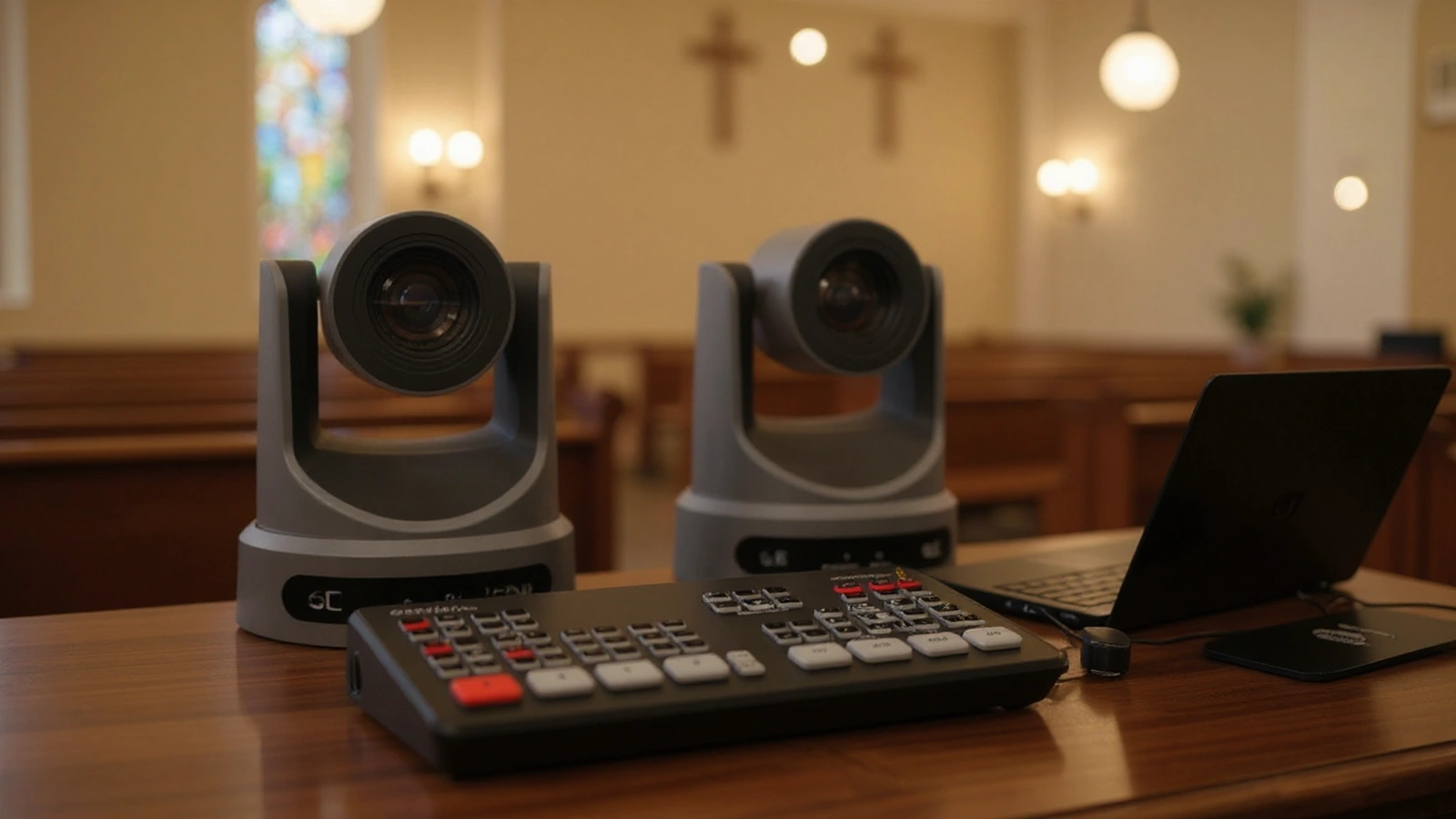
Worship is the part of the service that exposes a stream most. A spoken message forgives a single locked shot, but a worship set has movement, dynamics, and faces that the online congregation wants to see, and a camera setup that cannot follow it leaves the most engaging part of Sunday feeling flat on screen. The question worth answering, then, is whether the Move-SE 2-camera kit actually handles worship well, or just handles it adequately, and what it asks of the volunteer who runs it.
We build and support this kit constantly, so this is a working assessment from real rooms rather than a spec recital. We will look at the cameras during worship, the switcher that ties them together, how a volunteer runs it on a Sunday, and where the kit fits and where another configuration might fit better.
What is in the kit
The Move-SE 2-camera PTZ streaming kit with the ATEM Mini Pro pairs two matched PTZOptics Move-SE cameras with a Blackmagic ATEM Mini Pro switcher, along with the cabling and mounting guidance to bring it together. The Move-SE is a 1080p 60fps PTZ camera built on a Sony sensor, with HDMI, SDI, USB, and IP outputs and built-in auto-tracking, and it comes in 12x, 20x, and 30x zoom variants so the reach can be matched to your room. PTZOptics describes the Move SE on its product page as combining those output options with PTZ auto-tracking and full-HD video, which lines up with what we see in the field.
Because both cameras are the same model, the two angles share a sensor and the same image processing, which is the quiet feature that matters most for worship. A cut from a wide shot of the band to a close shot of the vocalist only feels seamless when the color and brightness match, and matched bodies give you that without a color-correction chase. The ATEM Mini Pro is the other half of the kit, and its job is to switch, encode, stream, and record so the system needs no separate production computer.
The cameras during a worship set
Worship is where the Move-SE’s optical zoom and image quality earn their place. From a back-of-room mount, a 30x camera can frame a tight, steady shot of a vocalist’s face, while the second camera holds a wide shot of the full team and the room, and that pairing is exactly the rhythm a worship stream wants. The Sony sensor gives a cleaner, more natural image than the security-camera-style sensors found in cheaper PTZ bodies, which shows most in the warm, uneven stage lighting that worship sets tend to live in.
Lighting is the honest caveat for any camera in a sanctuary, because rooms are usually dimmer than they look and stage lighting is rarely even. The Move-SE handles typical church worship lighting well, but it is not magic, so it is worth dialing in exposure and white balance on both cameras to match rather than leaving them on auto, where a spotlight or a color wash can pull one camera away from the other mid-song. Once those settings are set and saved, the cameras hold their look reliably from week to week.
Optical zoom is the spec to get right for worship specifically, because a close shot of a singer from the back of a long room is an optical-reach problem, not a resolution one. Choosing the zoom variant by your camera distance, rather than defaulting to the highest number, is the difference between a crisp closeup and a soft, over-zoomed one. Our overview of the best PTZ camera for church walks through matching zoom range to room size in more detail.
Auto-tracking and presets when worship moves
Worship leaders move, and a static close shot that the leader keeps stepping out of is worse than a wide shot that simply holds. The Move-SE’s auto-tracking is built for exactly this, because it can follow a presenter or vocalist who moves naturally across the platform and keep them framed without anyone operating the camera. For a church with no dedicated camera volunteer, that is the feature that makes a close shot during worship realistic rather than aspirational.
Presets are the companion tool. A volunteer can store framings for the worship leader, the full band, the keyboard, and a wide establishing shot, then recall any of them with a button, which keeps live movement off the stream and reduces the chance of a missed or shaky shot. Auto-tracking and presets are not a replacement for thought about where the cameras live and what they should follow, and they work best paired with good placement and the right optical reach. Used together, though, they let a single volunteer run a genuinely dynamic worship stream, which is the outcome the kit is really selling.
The ATEM Mini Pro tying it together
The switcher is what turns two cameras into one stream, and the ATEM Mini Pro is a strong fit for a two-camera worship setup. It has four HDMI inputs, so both cameras plug in directly and you still have room for a presentation feed of lyrics or a third camera later, and you cut between sources with a labeled button rather than a menu. The Blackmagic ATEM Mini product page confirms that the Pro encodes and streams directly and records to a USB drive, which means the kit captures your worship set to a file at the same time it streams, with no computer in the chain.
That direct workflow is a real advantage for worship specifically, because it keeps the system simple enough that a volunteer can run it under the time pressure of a Sunday morning. One detail worth understanding up front is that when the ATEM is connected to a computer over USB, the computer sees a single program feed rather than two separate cameras, which is precisely what you want for streaming and recording but surprises churches expecting independent camera sources. For most worship streams, the Pro’s all-in-one switching and recording is exactly the right amount of capability. Our walkthrough of the best ATEM Mini Pro live stream setup shows the full signal path if you want to see how it comes together.
Running it on a Sunday
The test that matters for any church kit is whether a volunteer can run it calmly while also caring about the service, and this is where the Move-SE 2-camera kit does well. A reasonable worship rhythm is to open wide on the full team, cut to a tracked or preset close shot on the lead vocalist during a verse, return to wide for the congregational moments, and let each shot hold long enough to feel intentional. Fewer, more deliberate cuts read as more produced than constant switching, and they keep the operator relaxed.
For a church that wants hands-on control of the cameras during worship, a PTZOptics joystick controller adds a tactile way to pan, tilt, zoom, and call presets, which suits a volunteer who enjoys operating live and wants to follow a soloist by hand. It is an optional addition rather than a requirement, since presets and auto-tracking carry most churches without it, and many teams add it once the basic workflow feels comfortable. Either way, the kit is designed so the worship stream does not depend on a broadcast professional being in the room.
Where this kit fits, and where another might fit better
The Move-SE 2-camera kit fits a church that wants two strong, matched angles for worship with the least possible operating burden, in a room where 1080p output is the target and the cameras can reach their shots optically. That covers a large share of churches, from a growing plant to an established congregation, because the kit balances image quality, supportability, and a workflow a volunteer can own.
Some churches will be better served by a neighboring configuration, and naming that honestly is part of a fair review. A church that wants room to record individual camera angles for later editing, drive an in-house screen, or add several more inputs will find the Move-SE 2-camera PTZ streaming kit with the ATEM Mini Extreme a more comfortable home, because the Extreme adds inputs and output flexibility the Pro is not built for. A church chasing the best possible image and wanting headroom to grow into more advanced camera behavior may prefer stepping up to the Move 4K 2-camera PTZ streaming kit with the ATEM Mini Pro, since a 4K camera can feed a cleaner downsampled 1080p image and leaves more room for the future. None of these is a better or worse kit in the abstract; each one simply fits a slightly different room and ambition.
The verdict for worship
For the specific job of streaming worship well with volunteers rather than professionals, the Move-SE 2-camera kit is one of the easiest recommendations we make. Matched cameras keep the cuts clean, auto-tracking and presets let one person run a dynamic stream, and the ATEM Mini Pro keeps the whole system inside a workflow a church can actually sustain week after week. It does ask you to set exposure and white balance thoughtfully and to choose the right zoom for your room, but those are afternoon tasks that pay off every Sunday after.
If your worship sets deserve more than a single locked frame and you want a system built for the way music moves on a platform, the Move-SE 2-camera PTZ streaming kit with the ATEM Mini Pro is the one we would set up for our own room first. To think through where the second camera lives before it arrives, our guide to church camera placement and where to mount your cameras is the natural next step.