
Blog
Four-camera ATEM Mini Extreme kit review for churches

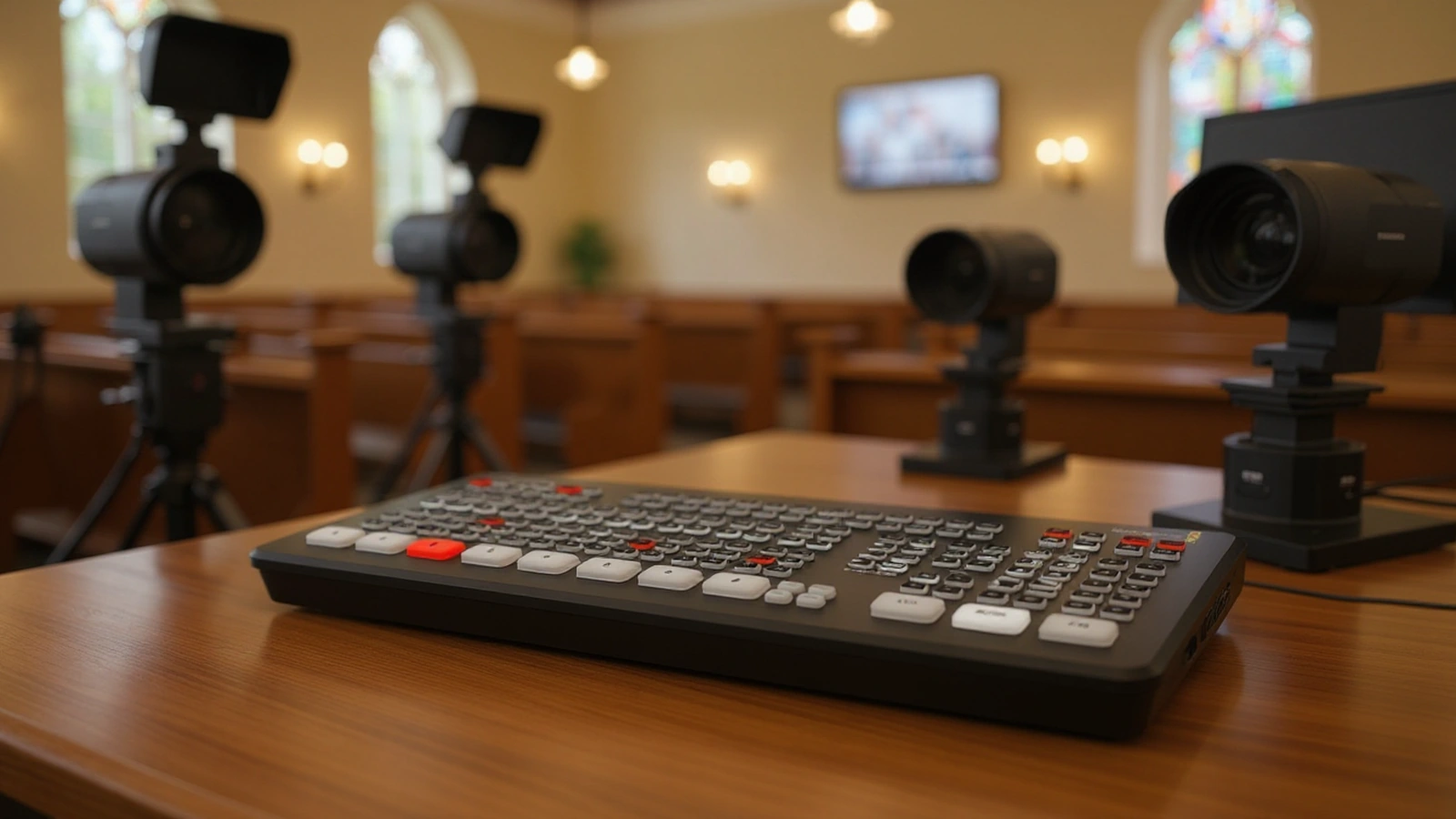
A four-camera kit built around the ATEM Mini Extreme is what a church reaches for when a single wide and a closeup no longer tell the whole story: a larger sanctuary, a full worship team, in-house screens to feed, and enough happening on the platform that four perspectives genuinely help the viewer follow along. We assemble and support these kits for churches every week, so this is less a spec recital and more a practitioner’s read on what the system does well, who it fits, and what to expect when it lands in your room. The short version is that the Extreme is the part that makes a real four-camera workflow comfortable rather than cramped, and the cameras you pair with it decide the image.
We will look at the switcher at the heart of the kit, the cameras and control that make four angles manageable, the setup reality, and the kind of church this system actually serves. Prices and firmware move over time, so treat any number here as a planning figure and confirm it on the live kit page before you commit.
Why the ATEM Mini Extreme is the right core for four cameras
The Extreme earns its place in a four-camera kit because of headroom, not just input count. It carries eight HDMI inputs, which means four cameras leave you four more inputs for a ProPresenter or lyrics feed, a second graphics source, and whatever else your service needs, instead of filling every slot with a camera and having nothing left. That margin is the difference between a system that runs your current service and one that still has room when you add an element next year. You can see the full input and output picture on the Blackmagic ATEM Mini product page.
The other reason it fits four cameras is the multiview. The Extreme can drive a monitor that shows every camera at once alongside program and preview, which is what makes running four angles humane for a single operator. Without a multiview, a four-camera operator is cutting partly on faith, trusting that the angles they cannot see are framed correctly. With it, they can confirm every shot before they take it, which directly improves how polished the stream looks. The Extreme also offers multiple outputs and SuperSource, so you can feed in-house image magnification and a multiview at the same time, a combination the four-input ATEM Mini Pro is not built to handle.
The four-input alternative, and why the Extreme wins here
It is worth being clear about where the ATEM Mini Pro stands, because it is an excellent switcher and the right core for many churches. With four HDMI inputs, the Pro can run a four-camera system if every input is a camera, and it streams and records directly at around 325 dollars, which makes it a superb value for a church that wants the simplest possible four-input box. For a two-camera or three-camera system, it is often the better choice precisely because it stays close to a push-button experience.
The Extreme becomes the better fit the moment you want four cameras and still need an input for graphics, an output for in-house screens, or a multiview for the operator. At that point the Pro is full, and asking it to do more than it was designed for is where a setup starts to feel constrained. The Extreme is built for that exact moment, which is why our four-camera kits are based on it. Both are good switchers; they simply fit different ceilings. If you are still deciding between them, our comparison of the best video switchers for churches lays out where each one lands.
The cameras: what you are framing with
A four-camera kit is only as good as the angles it captures, and the camera family is where you set the ceiling on image quality. The Move-SE four-camera kit with the ATEM Mini Extreme pairs the Extreme with four PTZOptics Move-SE cameras, each a 1080p60 PTZ with a Sony sensor, auto-tracking, and a choice of 12x, 20x, or 30x zoom. For most growing churches, this is the value sweet spot: clean multi-angle coverage, a switcher with real headroom, and a control workflow a volunteer can learn.
When you want the strongest image your budget allows across all four angles, the Move 4K four-camera kit with the ATEM Mini Extreme steps each camera up to 4K capture with a newer sensor, stronger low-light performance, PoE+, a built-in tally light, and a five-year warranty from PTZOptics. The honest caveat is that the Extreme is a 1080p switcher, so a 4K camera feeds it a cleaner downsampled 1080p picture rather than producing a 4K stream. The reason to choose Move 4K is image cleanliness, low-light margin, and room to grow, not a 4K broadcast. In a sanctuary with dim or uneven stage lighting, that low-light margin is often the deciding factor.
Control: how one volunteer runs four angles
The thing that determines whether a four-camera kit looks polished or chaotic is rarely the gear. It is whether the operator can keep four shots correct while watching one. That is where presets and the multiview do their real work together. Saving framings for the pulpit, the worship leader, a wide establishing shot, and a fourth angle on every camera turns four constant aiming jobs into a set of recallable buttons, so the operator calls up known-good shots rather than aiming live under pressure.
A joystick controller makes that workflow tactile, letting one person move cameras and call presets from a single seat, and it pairs naturally with the Extreme’s larger control surface. Auto-tracking on the Move-SE and Move 4K can take a moving presenter off the operator’s plate entirely, letting one camera follow the pastor while the operator concentrates on cutting the rest. None of these replace thoughtful production, but together they are why a single, reasonably practiced volunteer can run a four-camera service without it running them. Our walkthrough of setting up an ATEM PTZ live streaming kit shows the control workflow in action, and most of it carries directly to the Extreme.
Setup and what to expect on install day
Setting up a four-camera kit is more physical work than a smaller system, and it helps to know that going in. Each PTZ camera needs its own Power over Ethernet run back to a network switch, and the Move 4K draws PoE+, so the switch has to deliver enough power per port. Four cameras usually means four mounting points, four cable pulls, and a fourth angle that often lives somewhere new in the room. The cabling is the genuine labor; once it is run, the rest is far more forgiving than churches expect.
The part that keeps this from becoming overwhelming is that configuration does not scale the way cabling does. Once the cameras are on the network and the HDMI runs reach the Extreme, most of the setup, the camera settings, presets, and switcher configuration, can be handled remotely. That is the core of how we support these kits: you handle the physical install, and we help get the system dialed in so it works the way it should on Sunday. It is also why a kit tends to land below an integrator quote for similar hardware, since the difference is mostly on-site labor and markup rather than the gear itself.
Who this kit is for, and who should look smaller
A four-camera ATEM Mini Extreme kit is a strong fit for a specific kind of church: a larger or growing sanctuary, a service with a full worship team or choir, a room deep enough that a single closeup cannot cover both sides of the platform, and a team with two or three engaged volunteers who have time to learn the workflow. For that church, the Extreme’s headroom and the four angles are not overkill; they are the honest match to what is happening on the platform, and the system will scale gracefully as the ministry grows.
A church running on one tired volunteer each week, or one whose service is mostly a single speaker at a pulpit, will often get a more faithful stream from a two-camera or three-camera system run confidently. That is not a lesser path; it is a better fit for that reality, and the switcher decision usually stays at the ATEM Mini Pro in those cases. If you suspect you sit in that group, our comparison of the best camera setup for live streaming church can help you right-size before you commit to four angles. The kit rewards the team that is ready for it, so the most useful question is whether your team is there or building toward it.
The verdict
The four-camera ATEM Mini Extreme kit is the system we reach for when a church has genuinely outgrown two or three angles and wants production that can scale with the room. The Extreme is the right core because its inputs, multiview, and outputs make four cameras comfortable to run rather than cramped, and the Move-SE or Move 4K cameras decide whether you optimize for value or for image quality and low-light headroom. Paired with presets, a joystick, and auto-tracking, it puts a real multi-camera service within reach of a practiced volunteer instead of requiring a hired crew.
If your room and team fit that description, the most useful next step is to look at the complete kit and see everything that is included in one place. The Move-SE four-camera kit with the ATEM Mini Extreme is where most churches start when they want full four-angle coverage at the friendliest price, and the Move 4K four-camera kit with the ATEM Mini Extreme is there when image quality and low-light performance are the priority. Comparing the two is the easiest, lowest-pressure way to let your room and your team decide which one fits.