
Are PTZ cameras good for live streaming?

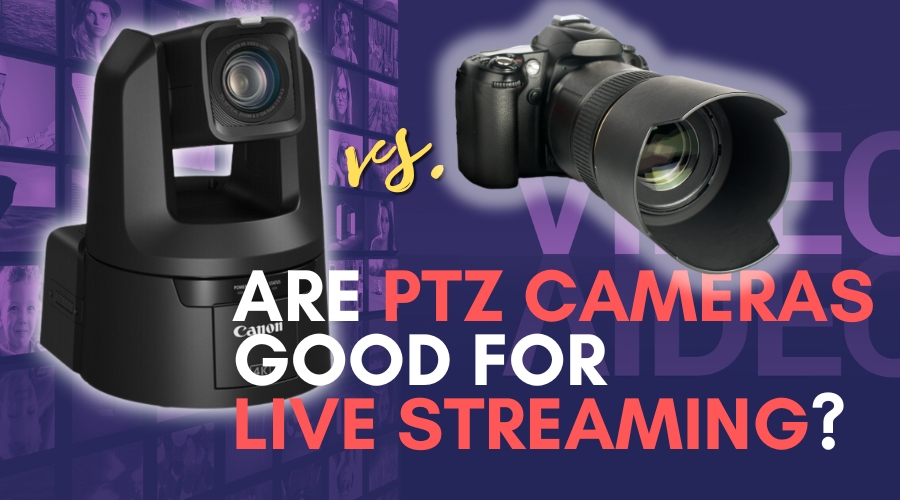
The most common question we get is, “What’s the best camera for live streaming?”
Answering that question is difficult because the truth is, it depends on a lot of different factors:
- If quality is your priority, the best camera probably costs around $30,000.00.
- If budget is your priority, the best camera might be around $1,000.00.
- If set it and forget it is your priority, it might be a static camera.
When it comes to church use, the most popular camera styles by far are the PTZ style cameras, for reasons we’ll get into in a minute when we answer all the reasons PTZ cameras are good for live streaming for churches, schools, theaters and more.
Why PTZ Cameras are Great for Live Streaming
Before we list the reasons we think PTZ cameras are the best choice, let me preface by saying all of this is subjective. There is no “one-size-fits-all best fit” for everyone. Personal preferences and budget are the biggest factors that determine if a certain camera is a good fit for your needs.
With that said, these are the reasons our customers love the PTZ camera streaming kits, and why you probably will too.
Control Multiple Cameras With a Single Volunteer
This is a big one for most churches that struggle to find willing volunteers in the tech booth. Having to put a person on every camera in the building requires a lot of people. However, with a PTZ streaming system, you only need a single operator sitting at the joystick controller. This person can operate more than 250 cameras using the same controller, all from a single location.
Remove Camera Shyness from the Audience

If you go to a big church with a large broadcasting budget, you’ll probably notice these large cameras up on huge tripods, and an operator wearing his big headset doing all kinds of fancy things. The thing most people dislike about this, is when they are in the heart of worship only to open their eyes and see a giant canon of a lens staring them in the face.
Cameras in the audience are noticed. It makes some people – most people – feel a little self-conscious when they think someone is videoing them – or worse – that thousands of people are looking at them on their computer screens as they ugly cry at the altar.
PTZ cameras, for the most part, disappear from the congregation. They are usually mounted on the wall or ceiling and often go unnoticed. And if anyone notices them, they are quickly forgotten.
They are silent, so no one hears them moving. And they really become invisible, letting the camera-shy folks in the congregation relax and forget about it.
PTZs Are Easy to Operate

Once you have a PTZ camera set, they are usually as easy as an old-style camcorder.
- Their focus is pretty good on autofocus
- You can save frame locations using presets and with a click of a single button move a camera to that location, all framed up for the perfect shot.
- You don’t need the producer on a headset communicating to a camera operator because the producer can operate the cameras himself.
- A single volunteer can run a full multi-camera live stream by themselves, although it’s easier if you have two – one running the switcher while the other moves the cameras.
PTZs Are Finally Affordable
Getting a quality image from a PTZ camera used to be like this:
- The cheap ones were glorified security cameras, with grainy, color-challenged images.
- The quality ones were $8,000.00 and up per camera
Now, however, quality and affordable are both available with brands like PTZOptics, and even Canon putting out cameras in the $2-$5k range.
So, Are PTZ Cameras a Good Live Streaming Option?
That’s up to you and what kind of experience you want to have.
It’s important to note that if image quality is prime in your use case, you cannot compare a $2500 PTZ camera with a $2500 handheld with a $1200 lens. A handheld cinema camera is basically a sensor in a body. The Pocket Cinema cameras from Blackmagic Design for example have no continuous autofocus, but their sensors are amazing 4K or 6K quality sensors. But then you have to have a quality lens as well.
PTZ cameras, on the other hand, are the sensor, plus the networking and remote-control motors, the autofocus engine, and, today, auto-tracking features, etc., etc. You are paying for much more than just a sensor with plastic around it.
So to compare the two is unfair, and granted a $2,000 PTZ camera is not going to give you the same look the mega-churches have with their $20k RED cameras. It won’t give you the cinematic look that you get with handhelds either.
What you will get is a high-quality image that looks more like broadcast television than cinema. And for church use, that’s more than okay for 95% of churches.