
ATEM Mini Pro review for church streaming teams

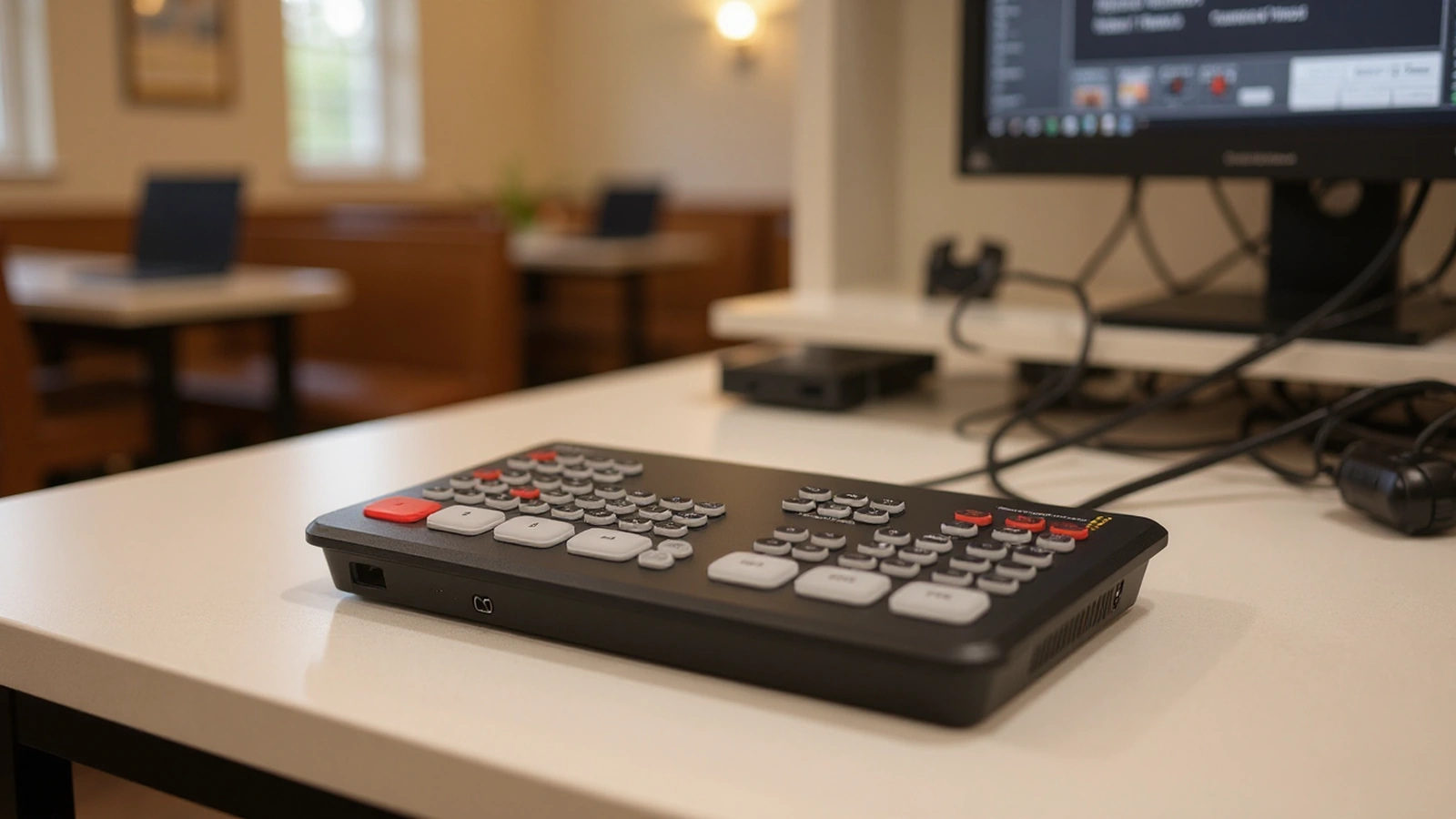
The ATEM Mini Pro has been the quiet workhorse inside more of our church kits than any other switcher, so when a streaming team asks whether it is the right box for them, we are answering from years of setting it up in real sanctuaries rather than from a spec sheet. For a church that wants a clean, reliable stream run by volunteers, it remains one of the easiest recommendations we make, and this review explains exactly why and where its limits sit.
We will look at what the box does well for a church specifically, the one limitation worth understanding before you buy, how it performs on an actual Sunday, and which kinds of churches it fits best. The goal is to help you decide with confidence, not to hand you a feature list.
What the ATEM Mini Pro is built to do
At its core, the ATEM Mini Pro is a four-input HDMI switcher with a hardware streaming engine built in, which is the combination that makes it so well suited to churches. According to the Blackmagic ATEM Mini Pro tech specs, it streams directly to YouTube, Facebook, or a custom destination over its ethernet port, records the program to a USB drive, outputs to a computer as a webcam for Zoom, and includes an audio mixer, transitions, and a chroma keyer, all in a box that costs in the low-to-mid three hundreds.
What that adds up to in practice is a complete production in a single unit. You do not need a powerful computer to encode the stream, because the encoding happens inside the switcher, and you do not need separate gear to record the service, because that lives in the box too. For a church that wants to get online cleanly without assembling a rack of components, this consolidation is the whole appeal.
Why it suits churches so well
The feature that matters most to a volunteer-run church is not on the spec sheet, it is the lighted buttons on the front. A person who has never touched broadcast gear can learn to cut between cameras in a few minutes, because the input you are sending to the stream is the one that is lit, and switching is a single press. That low barrier is the difference between a stream that depends on one trained person and a stream a rotating team can keep running.
The built-in standards conversion is another quiet strength for the real world. Each of the four HDMI inputs has its own converter that accepts 720p, 1080i, and 1080p sources at a range of frame rates, so a mix of a PTZ camera, a presentation laptop, and a different camera can all feed the same box without anyone matching formats by hand. The switcher then sends a clean 1080p program out, which is the resolution churches actually stream in. We walk through this setup end to end in our tutorial on setting up the ATEM Mini Pro PTZ live streaming kit.
Reliability rounds it out. A dedicated box with one job and no general-purpose operating system has far fewer ways to fail mid-service than a computer juggling updates and background apps, which is why we so often reach for it when a church tells us the stream has to start the same way every week. The Move-SE 1-camera kit with the ATEM Mini Pro packages that dependability with a quality PTZ camera as our most popular starting point.
The one limitation worth understanding
Every good tool fits a certain shape of job, and the ATEM Mini Pro’s shape is four HDMI inputs and a single program output to work with. That input count suits the camera counts most churches actually run, but it is the ceiling to know about: a church wanting more than three or four angles, or one that needs to drive an in-house image-magnification screen and a multiview monitor at the same time, is reaching past what this model is built for. That is not a flaw, it is simply where the ATEM Mini Extreme picks up, with more inputs and the output flexibility to feed in-house screens.
The second thing to understand is the USB behavior, because it surprises people. When you connect the ATEM Mini Pro to a computer over USB, it presents its program feed as one webcam source rather than four separate cameras, so software on that computer sees the switched output, not each input independently. For the common workflow of switching on the box and streaming directly, this is exactly what you want. It only matters if you specifically need the computer to access each camera on its own, in which case a different production model fits better. Our overview of the best video switchers for churches lays out where each ATEM model lands.
How it holds up on an actual Sunday
The truest test of any switcher is the unremarkable Sunday, the one where nothing dramatic happens because the gear simply did its job. In that test the ATEM Mini Pro consistently delivers, because the operator powers it on, the inputs come up, and the same button press that worked last week works this week. There is a reassuring sameness to it that volunteers come to rely on, and reliability that you can take for granted is worth more than features you rarely touch.
Audio is where many churches discover the box’s depth. The built-in mixer lets you take a clean feed from your sound board and balance it against camera microphones, so the congregation at home hears the same quality of sound as the room rather than a distant camera mic picking up echo. Getting good audio into the switcher is the single biggest upgrade to most streams, and if your sound has frustrated you, our guide to why live stream audio sounds bad is worth reading alongside this review.
The box also pairs naturally with PTZ cameras, which is how it reaches its full potential for a church. Because PTZ cameras hold presets, one volunteer at the switcher can call up a wide shot, a tight shot of the speaker, and a worship-band angle and cut between them without anyone operating a camera by hand. That combination of a simple switcher and preset-driven cameras is what lets a small team produce a multi-angle service, and it is the heart of the way we build kits.
Where it fits, and where it does not
The ATEM Mini Pro fits best where simplicity and reliability outrank layered graphics, which describes the majority of churches we serve. A church plant with one camera, a growing church with two or three angles, and any congregation that wants a volunteer to run the stream without a training session are all squarely in its wheelhouse. The Move-SE 2-camera kit with the ATEM Mini Pro is a particularly natural fit for a church that wants real movement between a wide shot and a tight one while keeping operation to a single seat.
It is a less natural fit when a church needs many camera angles at once, wants to drive in-house screens and a multiview simultaneously, or builds heavily layered graphics into every scene. None of those needs make the Pro a poor box; they simply point toward an ATEM Mini Extreme for more inputs and outputs, or toward a hybrid setup that adds software for graphics. A church anticipating that kind of growth can still start on the Pro and step up later, since the skills and the cameras carry forward.
How it compares to the alternatives
Against a software-based stream on a computer, the ATEM Mini Pro trades some flexibility for a great deal of dependability. Software can layer videos, slides, and animated lower-thirds in ways a compact switcher cannot, but it leans on a healthy computer and a confident operator, while the Pro keeps the live camera cut on hardware that does not crash mid-service. Many churches end up with the best of both by switching on the box and feeding its webcam output into software only when they want graphics.
Against the base ATEM Mini, the Pro is the model we actually recommend for churches, because the plain Mini lacks the built-in streaming and recording engine that make the Pro a complete solution. The step up is modest in price and large in capability, since it removes the need for a separate encoding computer entirely. For a fuller account of where this box sits in our thinking over the years, our piece on whether the Blackmagic ATEM Mini Pro is a good choice for church live streaming is a useful companion to this review.
Our verdict and a sensible next step
After years of building church kits around it, our assessment is straightforward: the ATEM Mini Pro is one of the best values in church streaming for a congregation that wants a reliable, volunteer-friendly system without the cost and fragility of a computer-based rig. Its four inputs and single program output define who it is for, and for the great majority of churches that shape is exactly right. The teams who outgrow it tend to do so happily, stepping up to an Extreme or a hybrid setup with the same skills intact.
If this sounds like your church, the cleanest way to put it to work is a matched kit so the camera, cabling, and switcher are chosen to fit together. The Move-SE 1-camera kit with the ATEM Mini Pro is our most popular complete single-camera system, and the Move-SE 2-camera kit with the ATEM Mini Pro adds the movement that lifts a stream from static to produced. Tell us your room and your team, and we will help you land on the version that will still be serving you well several years from now.