
Does Live Streaming Hurt Church Attendance? What the Data Shows

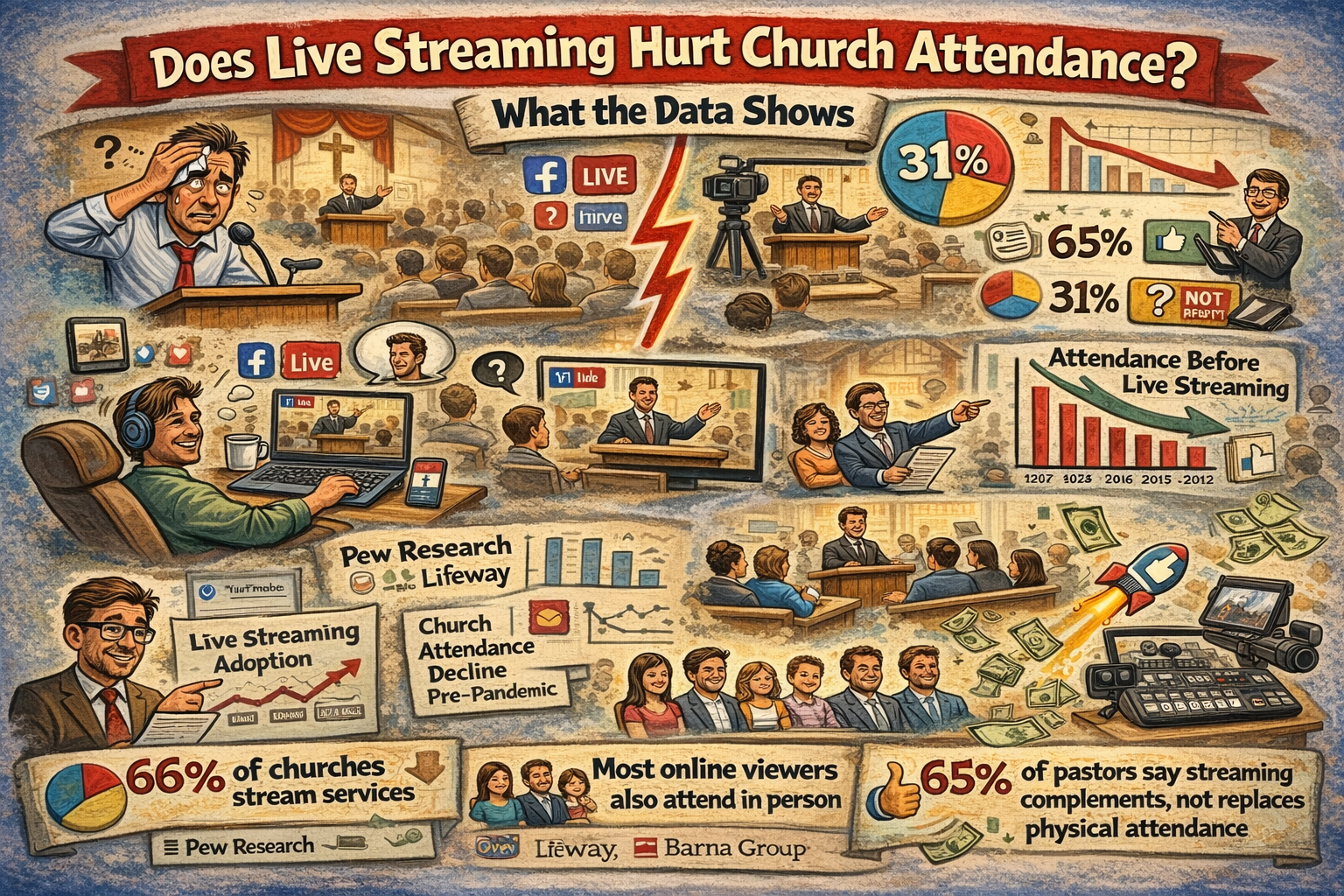
Church live streaming refers to the real-time broadcast of worship services, sermons, and other church events over the internet. Viewers access these broadcasts through platforms such as YouTube, Facebook Live, or proprietary church apps. The practice existed in a limited capacity before 2020 but became widespread during COVID-19 pandemic lockdowns, when in-person gatherings were restricted or prohibited.
Pre-Pandemic Church Attendance Trends
Church attendance in the United States has declined steadily for decades, driven by generational secularization rather than any single technological factor. Gallup reported in 2023 that approximately 31% of the U.S. population attended church regularly, down from 42% in 2008. The National Congregations Study conducted by Duke University in 2021 recorded a median weekend attendance of 65 people per congregation, down from 75 in 2012.
These declines preceded the widespread adoption of live streaming technology. Pew Research Center data confirms that the rise of religious disaffiliation tracks with generational cohort changes, not with the introduction of digital worship platforms. Any analysis of streaming’s effect on attendance must account for this pre-existing downward trajectory.
Rate of Live Streaming Adoption Among Churches
LifeWay Research reported in January 2023 that 66% of Protestant churches in the United States were streaming their worship services. A 2021 LifeWay survey found that 96% of pastors said their church had streamed at least one worship service in the prior year, up from roughly 50% before the pandemic (LifeWay Research, 2021).
The rapid adoption was primarily crisis-driven. Churches that launched streaming during lockdowns often continued the practice afterward, citing expanded reach and engagement with remote members. Churches equipping themselves with dedicated streaming hardware, such as a budget church live streaming kit, replaced ad hoc smartphone setups with more reliable and visually consistent broadcasts.
What Survey Data Shows About Streaming and In-Person Attendance
LifeWay Research Findings
Among churches that stream services, 65% of pastors reported in 2023 that streaming had not negatively affected in-person attendance (LifeWay Research, 2023). Many churches reported that online viewers who were previously unchurched or disconnected from a congregation eventually visited in person. LifeWay classified streaming as a complement rather than a replacement for physical attendance.
Barna Group Findings
Barna Group research from 2022 found that approximately 31% of practicing Christians had not returned to pre-pandemic in-person attendance levels. However, Barna noted that a majority of those who watched services online also continued attending in person. Prior to the pandemic, only 2% of churchgoers identified online services as their primary form of church participation (Barna Group, 2020).
Pew Research Center Findings
Pew Research Center reported in 2022 that 40% of U.S. adults who attend religious services also watched services online or on television in the previous month. Only approximately 10% of respondents watched exclusively online. The data indicates that online viewership is concentrated among people who already attend in person, not among those substituting digital access for physical presence.
Grey Matter Research Findings
A 2021 study commissioned by the National Association of Evangelicals and conducted by Grey Matter Research found that 72% of regular churchgoers who streamed during the pandemic intended to return to in-person attendance. Follow-up data from 2022 showed that approximately 65% had resumed regular in-person attendance. Those who did not return cited health concerns, schedule changes, and geographic relocations more often than a preference for the online format (Grey Matter Research, 2022).
Total Reach: In-Person Attendance Versus Combined Attendance
The Hartford Institute for Religion Research surveyed 2,074 congregations in 2021 and found that median in-person attendance had declined 30-35% from pre-pandemic levels. However, when online viewers were included, total reach for most congregations exceeded pre-pandemic numbers (Hartford Institute, 2021). A 2023 follow-up study by the Hartford Institute found that congregations with high-quality streaming programs recovered in-person attendance faster than congregations without streaming.
ACS Technologies reported in its 2022 Church Technology Survey that 74% of churches using streaming technology saw attendance stabilize or increase within 18 months of launching a stream. Churches with consistent, high-quality broadcasts reported first-time visitor increases of 10-15% (ACS Technologies, 2022).
Online Viewer Demographics and Behavior
Online-only viewers tend to fall into distinct categories rather than representing a general substitution of physical attendance. Common online-only viewer segments include homebound individuals, frequent travelers, prospective visitors evaluating a church before attending, and former members who relocated geographically. These groups would not contribute to in-person attendance numbers regardless of whether a stream existed.
Pushpay’s 2023 “Church Engagement Trends” report found that churches offering online streaming saw 12% higher overall engagement — including giving, small group participation, and volunteering — compared to churches that did not stream (Pushpay, 2023). Online-only viewers gave at lower rates than in-person attendees, but their contributions represented incremental revenue that churches would not have received without a streaming option.
The Role of Production Quality
Multiple studies correlate production quality with both viewer retention and eventual in-person visits. The Hartford Institute’s 2023 findings specifically noted that congregations with higher production values in their streams recovered in-person attendance more quickly. Low-quality streams with poor audio, unstable video, or inconsistent framing can misrepresent the in-person worship experience and deter potential visitors.
Churches that transition from single-camera smartphone setups to multi-camera configurations report measurable improvements in online viewer engagement. A 2-camera live streaming kit provides angle variety that maintains viewer attention during longer services. PTZ (pan-tilt-zoom) cameras, such as those included in a 3-camera PTZ live streaming kit, allow remote camera operation, reducing the number of required volunteers while improving shot composition.
All-in-one streaming solutions like the YoloBox Pro consolidate switching, encoding, and monitoring into a single portable device, lowering the technical barrier for smaller congregations. For churches requiring broadcast-grade color accuracy, systems built around the Canon CR-N300 PTZ camera deliver consistent skin tones and image quality that reflect the actual in-person experience.
Factors That Influence Whether Streaming Reduces In-Person Attendance
Several variables determine whether streaming displaces or supplements physical attendance at a given congregation:
- Intentional follow-up. Churches that actively invite online viewers to in-person events, small groups, or newcomer classes convert viewers to attendees at higher rates.
- Content differentiation. Some churches offer abbreviated or modified online experiences that preserve the distinctiveness of in-person worship.
- Community integration. Congregations with strong relational networks (small groups, volunteer teams, fellowship events) give members reasons to attend in person that a stream cannot replicate.
- Geographic reach. Streaming extends access to individuals outside a congregation’s geographic area. These viewers represent net-new reach, not displaced in-person attendees.
Summary of Data Findings
The available research from LifeWay, Barna Group, Pew Research Center, Grey Matter Research, the Hartford Institute, ACS Technologies, and Pushpay converges on a consistent conclusion. Live streaming does not appear to be a primary driver of declining church attendance. The broader attendance decline in the United States is attributable to secularization trends that predate streaming technology by decades.
Streaming functions predominantly as a supplement to in-person attendance. The majority of regular online viewers also attend in person. Online-only viewers tend to belong to demographic categories that would not attend in person regardless. Churches that invest in consistent, high-quality streaming infrastructure — such as a dedicated ATEM Mini Pro streaming kit or a Roland SR-20HD streaming mixer — report higher overall engagement and faster post-pandemic attendance recovery than churches without streaming programs.