
Hybrid Church Is Not Just Streaming Your Service

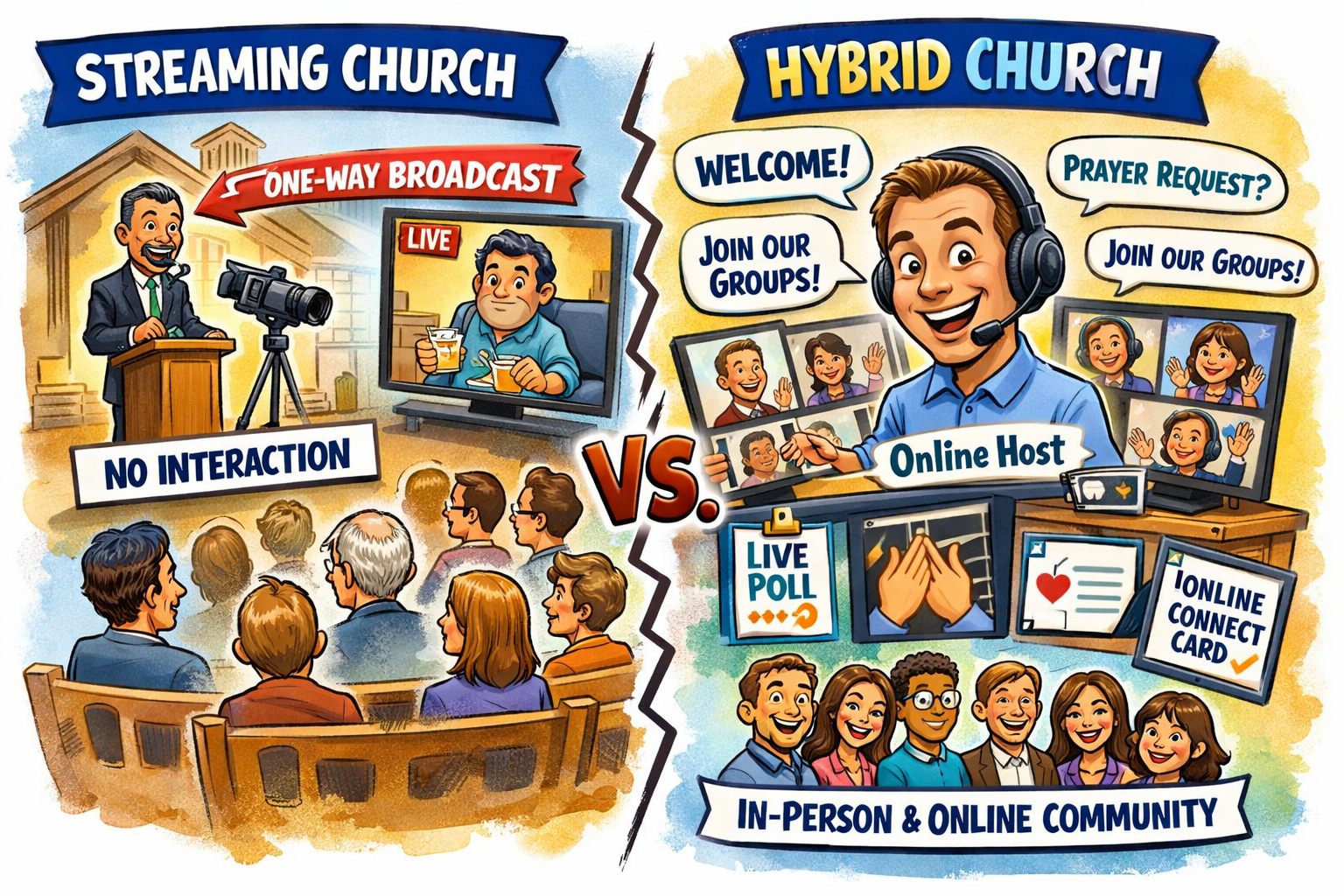
A hybrid church is a congregation that simultaneously operates both an in-person worship experience and a structured online worship experience, with intentional programming, staffing, and engagement strategies designed for each audience. This model differs from livestreaming, which involves broadcasting an in-person service to a passive online audience without dedicated interaction or follow-up pathways.
Livestreaming transmits a one-directional video feed of the physical service. Hybrid church treats the online audience as a distinct congregation requiring its own hosts, engagement tools, content adaptations, and discipleship systems. The distinction is operational, not merely technological.
Classification: Streaming vs. Hybrid Models
Church digital ministry models fall into three categories based on the level of intentionality directed toward the online audience. Each category represents a different operational commitment to the remote congregation.
Stream-Only Model
The stream-only model broadcasts the in-person service through a platform such as YouTube Live or Facebook Live. Online viewers watch the same content as the in-person audience with no modifications. No dedicated staff member monitors or interacts with the online audience. This model functions as a one-directional broadcast.
Enhanced Streaming Model
The enhanced streaming model adds production elements to the broadcast feed, including multi-camera switching, graphics overlays, and a separate audio mix optimized for remote listening. The content remains identical to the in-person service, but the visual and audio quality is adapted for screen-based consumption. Interaction with the online audience remains limited or absent.
Hybrid Church Model
The hybrid church model assigns dedicated staff or volunteers to serve the online congregation during each service. An online host greets viewers, moderates chat, relays prayer requests, and facilitates real-time interaction. The church maintains separate follow-up pathways, connection workflows, and small group options for online attendees. Content may include online-specific segments such as pre-service welcomes or digital-only announcements.
Engagement Differences Between Streaming and Hybrid
LifeWay Research reported in January 2023 that 53% of Protestant churches with an online presence described their approach as streaming the in-person service rather than operating a distinct online experience (LifeWay Research, 2023). Churches using a stream-only approach experienced significant audience attrition after the initial pandemic-era surge.
Barna Group data from 2024 indicated that only 23% of churches streaming services had a dedicated strategy for engaging online attendees during the service (Barna Group, 2024). The remaining 77% relied on the broadcast itself, with no interactive elements or assigned online hosts.
Churches that implemented intentional hybrid strategies reported 30% higher overall engagement across both in-person and online attendees compared to churches that only streamed (LifeWay Research, 2024). Engagement in this context refers to measurable actions: chat participation, digital connection card submissions, return viewer rates, and average watch duration.
Core Components of a Hybrid Church Strategy
Six operational elements distinguish a hybrid church from a stream-only approach.
Online Host or Moderator
A designated person monitors the chat, greets first-time online viewers, reads prayer requests aloud or routes them to a prayer team, and maintains ongoing interaction with the digital audience. This role serves the same functional purpose as a greeter or usher in a physical lobby.
Real-Time Interactive Tools
Chat windows, live polls, prayer request forms, and digital connection cards give online attendees a mechanism for active participation. These tools move the online experience from passive viewing to bidirectional engagement.
Separate Audio and Video Production
A broadcast-quality audio mix, distinct from the in-house sound reinforcement mix, ensures that online viewers receive balanced, intelligible audio. Multi-camera video production with switching, graphics, and lower thirds adapts the visual presentation for screen-based viewing. A 3-camera live streaming kit provides the camera coverage needed to create varied shot compositions, including wide congregation shots, speaker close-ups, and worship team angles.
Custom Content for Online Viewers
Pre-service countdown sequences, online-specific welcome segments, and post-service digital discussion prompts create a distinct experience for the remote audience. These elements acknowledge the online congregation as a separate group with different contextual needs.
Separate Follow-Up Pathways
Digital connection cards submitted through the stream interface trigger automated follow-up sequences. First-time online viewers receive different communication than first-time in-person visitors. Online-specific small groups, hosted via video conferencing platforms, provide a community pathway that does not require physical attendance.
Dedicated Metrics and Evaluation
Hybrid churches track online-specific key performance indicators (KPIs) separately from in-person attendance. Relevant online metrics include average watch duration, peak concurrent viewers, chat messages per service, digital connection card submissions, and return viewer percentage. These metrics inform operational decisions about staffing, content, and technology investment for the online campus.
Technical Infrastructure for Hybrid Church
The technical requirements for a hybrid church exceed those of a basic livestream. A stream-only setup may rely on a single camera and a direct feed to a social media platform. A hybrid church requires a production system capable of multi-camera switching, graphics overlay, and separate audio mixing.
Video Switching and Encoding
A hardware video switcher or an all-in-one streaming encoder processes multiple camera feeds into a single program output. The Roland SR-20HD streaming AV mixer handles video switching, audio mixing, and direct streaming output in a single unit, which reduces the number of separate components required. Blackmagic Design ATEM Mini Pro switchers and YoloLiv YoloBox units serve similar functions at different price points and feature levels.
Camera Systems
PTZ (pan-tilt-zoom) cameras enable a single operator or preset-based automation to cover multiple angles without requiring a dedicated camera operator at each position. A 3-camera PTZ live streaming kit with 20X zoom provides the optical reach needed for speaker close-ups from fixed mounting positions in a worship venue. Fixed-lens cameras on tripods or wall mounts serve smaller venues where fewer angles are sufficient.
Audio for Broadcast
A separate broadcast audio mix, sometimes called a “dirty feed” or “broadcast split,” routes a dedicated mix to the streaming encoder. This mix balances spoken word, instruments, and vocals for headphone and speaker listening rather than room reinforcement. Churches without a separate broadcast mix often produce streams where the spoken word is unintelligible due to room reverberation and unbalanced levels.
Online Engagement Station
A dedicated computer or tablet at the production area or in a separate room serves as the online host station. This device runs the streaming platform’s chat interface, prayer request management tools, and any church management software used for digital connection card processing. The online host monitors and responds to the chat in real time during the service.
Staffing and Volunteer Structure
Operating a hybrid church requires roles that do not exist in a stream-only model. The minimum additional staffing includes an online host, a technical director or stream operator, and a follow-up coordinator for online attendees.
Larger hybrid operations may add chat moderators, online prayer team members, and a digital campus pastor who oversees the online congregation’s pastoral care, discipleship programming, and community building. Hartford Institute for Religion Research survey data from 2023 found that only 12% of congregations operating hybrid worship had dedicated staff or volunteers assigned specifically to online attendee engagement (Hartford Institute, 2023).
Common Failure Modes
Several patterns cause hybrid church initiatives to underperform or revert to stream-only operation. Each failure mode reflects a gap in operational commitment rather than a technology limitation.
Treating the Stream as an Afterthought
Congregations that assign no dedicated personnel to the online audience produce a broadcast without engagement. Online attendance declines predictably, and leadership interprets the decline as lack of interest rather than lack of investment.
Identical Content Without Adaptation
In-room announcements, spatial references (“stand and greet those around you”), and physical participation cues exclude online viewers. Hybrid churches adapt or supplement these moments with online-specific alternatives.
No Separate Metrics
Without online-specific KPIs, leadership lacks visibility into the health and growth of the digital congregation. In-person headcount alone does not reflect the full scope of the church’s ministry reach.
Underinvestment in Production Quality
Poor audio quality, a single static camera angle, and absence of graphics reduce the online viewing experience below the threshold at which remote attendees remain engaged. Multi-camera production with an ATEM Mini Pro 2-camera streaming kit provides visual variety that sustains viewer attention over the duration of a service.
Adoption Rates and Trends
LifeWay Research reported in January 2023 that 71% of Protestant churches offered some form of online service, a decline from 97% during the peak of COVID-19 restrictions in 2020 (LifeWay Research, 2023). The decline indicates that many churches discontinued online services rather than transitioning to a hybrid model.
Hartford Institute for Religion Research data from 2023 indicated that 30% of American congregations were operating some form of hybrid worship, defined as simultaneously serving both in-person and online congregations (Hartford Institute, 2023). Pew Research Center found in 2022 that 40% of U.S. adults who attend religious services reported attending online at least some of the time (Pew Research Center, 2022).
The data indicates that online attendance demand persists at measurable levels, but the majority of congregations have not built the operational infrastructure to serve that audience intentionally.
Product Integration for Hybrid Church Infrastructure
Building a hybrid church production system requires equipment that supports multi-camera switching, broadcast-quality audio, and graphics integration. The following product categories address the technical requirements outlined above.
Multi-camera streaming kits provide camera hardware, switching, and encoding in preconfigured packages. A 2-camera live streaming kit covers basic multi-angle production for small to medium venues. Larger worship spaces benefit from three-camera configurations that add a dedicated wide shot or balcony angle.
All-in-one encoders such as the YoloBox portable multi-camera live streaming studio combine switching, encoding, monitoring, and streaming into a single portable device. This form factor reduces setup complexity and is suitable for congregations without a permanent production booth.
PTZ cameras with NDI or HDMI output enable remote operation from a single control point. The PTZOptics Move 4K 30X camera provides 4K resolution and 30X optical zoom, which allows tight framing of a speaker from a rear-of-room or balcony mounting position. PTZ cameras reduce the number of volunteer camera operators required per service.
Dedicated streaming computers handle software-based encoding, graphics overlay, and multi-destination streaming for congregations that require more flexibility than hardware encoders provide. A premium multi-camera streaming computer is configured for simultaneous multi-source ingest and encoding workloads.