
Live Streaming Won’t Fix a Disconnected Church Culture

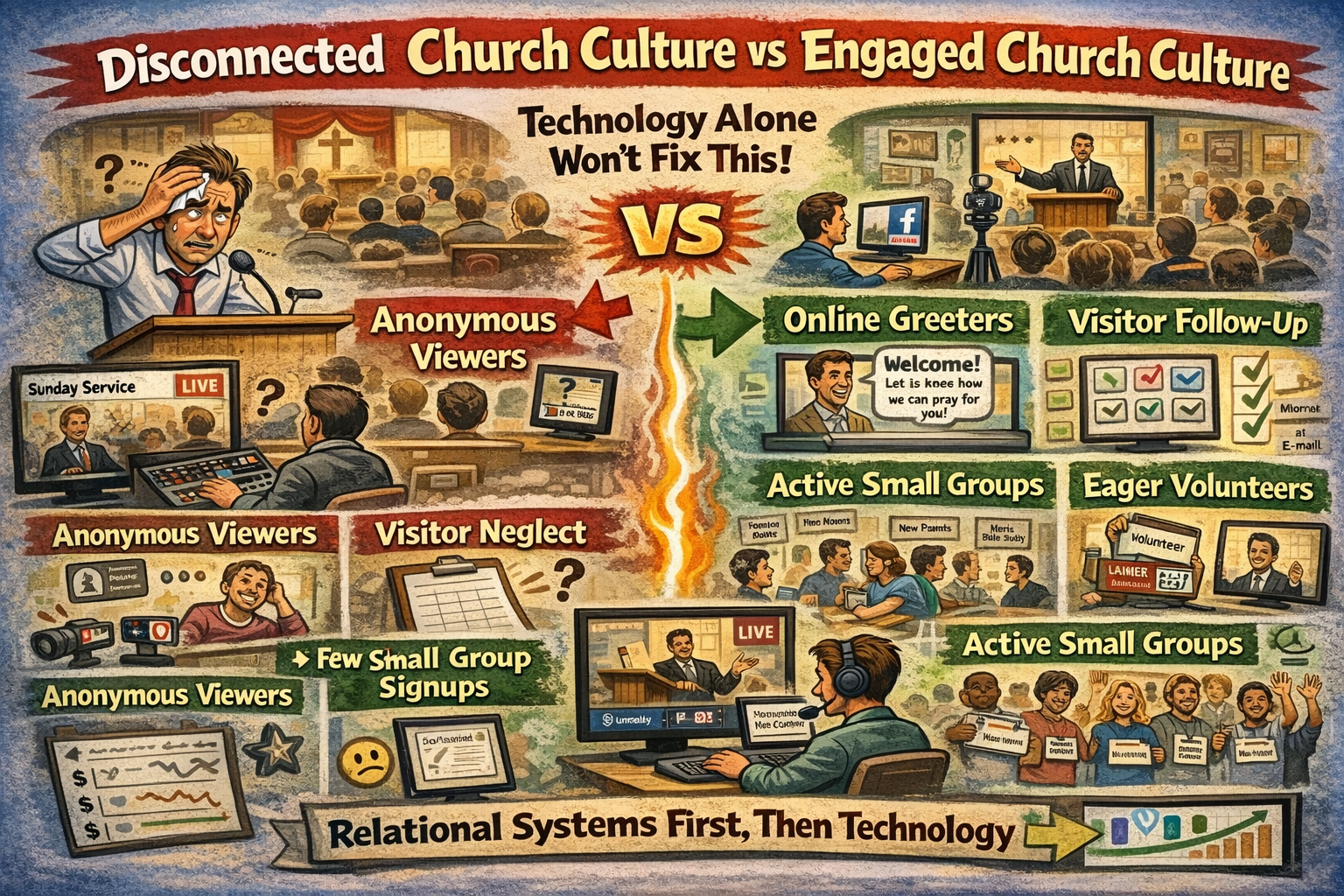
Disconnected church culture refers to a congregational environment in which attendees — whether in person or online — experience minimal relational engagement, limited follow-up from leadership, and few pathways into communal participation beyond passive service attendance. The condition is organizational and relational in nature, not technological. It is characterized by low small group participation rates, absent or inconsistent visitor follow-up systems, limited volunteer integration, and a general pattern of anonymous consumption of worship content.
The Technology-First Assumption
A common assumption among church leadership teams is that adding or upgrading live streaming technology will resolve declining engagement and community disconnection. This assumption conflates visibility with connection. Barna Group reported in 2024 that 64% of practicing Christians affirm the importance of church community, yet only 30% report feeling deeply connected to a local congregation. The gap between valuing community and experiencing it is not a production quality problem.
ACS Technologies reported in 2024 that 78% of churches that launched live streaming during 2020 did so without a written strategy for engaging online viewers. The technology was deployed as a broadcast mechanism rather than as a component of a broader relational infrastructure. Churches that treat streaming as a solution to cultural disconnection misidentify the root cause: the absence of intentional systems for moving individuals from observation to participation.
Classification of Church Engagement Problems
Church engagement problems fall into two broad categories: infrastructure problems and culture problems. The distinction determines whether a technology investment will produce measurable results.
Infrastructure Problems
Infrastructure problems are those caused by inadequate or absent technical systems. A church that lacks any streaming capability cannot reach remote viewers. A church using a smartphone propped against a hymnal produces video quality that misrepresents the in-person experience. These are solvable through equipment acquisition. A budget church live streaming kit addresses the baseline infrastructure gap by replacing ad hoc smartphone setups with consistent, professional-grade output. Multi-camera systems such as a 2-camera live streaming kit provide angle variety that sustains online viewer attention across a full service.
Culture Problems
Culture problems are those rooted in congregational behavior, leadership practices, and organizational systems. Examples include failure to follow up with first-time visitors, absence of small group pathways, lack of digital hospitality practices for online viewers, and over-reliance on Sunday morning programming as the sole point of contact. Grey Matter Research reported in 2023 that 49% of churchgoers indicated their church does not follow up with visitors within a week of their first attendance. No camera upgrade resolves that gap.
The Problem of Passive Consumption
Live streaming, by design, enables passive consumption. The viewer watches without being watched. There is no handshake, no name tag, no conversation in the lobby, and no invitation to stay for coffee. Carey Nieuwhof’s analysis in 2023 estimated that 57% of online church viewers watch for less than 20 minutes per session. Lifeway Research reported the same year that 63% of pastors found online viewers harder to connect with relationally than in-person attendees.
Barna Group data from 2023 indicates that 35% of practicing Christians who watch services online report never attending the same church in person. Online-only attendees demonstrate lower rates of Bible reading, prayer, and financial giving compared to in-person attendees. The stream provides access to content but does not, by itself, generate community formation. Passive consumption becomes the default behavior when no interactive engagement layer exists alongside the broadcast.
Digital Hospitality as a Required Companion to Streaming
Digital hospitality refers to the set of practices, systems, and workflows that create relational entry points for online viewers. It is the digital equivalent of a greeter at the door, a welcome card in the pew, and a follow-up phone call during the week. Pushpay and Church Community Builder reported in 2024 that only 23% of churches have a formal digital engagement strategy beyond live streaming itself.
Churches that implement digital hospitality systems alongside streaming infrastructure see measurably different outcomes. Subsplash reported in 2023 that churches with integrated digital follow-up systems — including live chat, online connection cards, and virtual small group invitations — achieve 3x higher retention of online visitors compared to churches that only broadcast services. The stream creates the initial contact; the hospitality system determines whether that contact develops into a relationship.
Community Formation Requires Intentional Systems
The National Congregations Study found that churches relying primarily on broadcast models without interactive community systems report 40% lower retention rates for new visitors. Duke Divinity School research from 2023 confirmed that churches pairing streaming technology with intentional community-building practices — small groups, follow-up workflows, online prayer teams, and mentorship programs — report 2.5x higher engagement than churches that simply broadcast services without those systems.
Harvard Divinity School research from the same period identified a pattern described as “digital spectatorship,” in which technology adoption without accompanying cultural change in congregational practices produces viewers rather than participants. The Unstuck Group reported in 2024 that among churches experiencing growth, 82% attribute their gains to relational systems and community integration rather than production quality improvements alone. The technology serves as an entry point. The relational infrastructure determines whether viewers become participants.
The Role of Production Quality Within a Broader Strategy
Production quality remains a relevant variable. Viewers are approximately twice as likely to remain engaged with broadcasts that feature professional multi-camera setups versus single static shots. A system such as the ATEM Mini Pro 2-camera streaming kit delivers broadcast-grade switching and encoding in a format accessible to volunteer-operated production teams. PTZ camera systems, including models like the PTZOptics Move 4K 30X, enable remote camera operation with intelligent tracking, reducing staffing requirements while maintaining dynamic shot composition.
However, production quality operates within a ceiling defined by the church’s relational systems. A technically excellent broadcast that deposits viewers into an empty digital lobby — no chat, no follow-up, no invitation to connect — produces high-quality passive consumption. The investment in equipment achieves its intended return only when paired with the engagement systems that convert viewership into participation.
Indicators That Disconnection Is Cultural, Not Technical
Several observable indicators distinguish a culture problem from a technology problem:
- Low follow-up rates. First-time visitors, whether online or in person, receive no contact within seven days.
- Minimal small group participation. Fewer than 30% of regular attendees are enrolled in a small group, class, or recurring relational gathering.
- Anonymous online viewership. The church has no mechanism for identifying, contacting, or engaging online viewers beyond the stream itself.
- Volunteer scarcity. Active volunteer participation falls below 20% of regular attendees, indicating weak pathways from attendance to ownership.
- Giving stagnation. Per-capita giving declines or stagnates despite stable or growing attendance numbers, suggesting low commitment depth.
When these indicators are present, streaming equipment upgrades will not reverse the trend. The investment sequence matters: relational systems first, then technology to amplify their reach.
Practical Integration: Technology Serving Culture
Churches that achieve high engagement consistently integrate streaming technology into a broader ecosystem of relational touchpoints. The following elements define that integration:
- Pre-service digital welcome. Online viewers receive a greeting, orientation, and invitation to identify themselves through a digital connection card before the service begins.
- Real-time interaction. A moderated live chat or prayer request system operates during the broadcast, staffed by trained volunteers.
- Post-service follow-up. Automated and personal follow-up contacts reach online viewers within 24-48 hours of their first interaction.
- Small group onramps. Online viewers receive direct invitations to virtual or hybrid small groups based on geographic location or interest.
- Recurring engagement loops. Midweek digital content, devotionals, or community check-ins maintain relational continuity between Sundays.
Within this framework, professional streaming equipment — from entry-level kits like the Yolobox live streaming kit to multi-camera PTZ configurations paired with a premium streaming computer — functions as the delivery mechanism for a relational strategy rather than a substitute for one.
Summary
Live streaming technology is a distribution tool. It transmits content from one location to many screens. It does not, by itself, generate community, foster relationships, or convert viewers into participants. Disconnected church culture is a systemic condition rooted in absent or inadequate relational systems: follow-up workflows, small group pathways, digital hospitality practices, and volunteer integration processes.
Churches experiencing cultural disconnection that invest exclusively in streaming technology without addressing these systemic gaps will observe improved production quality and unchanged engagement metrics. The data from Barna Group, Duke Divinity School, the Unstuck Group, and Pushpay converges on a consistent finding: technology amplifies existing culture. A connected church culture, paired with professional streaming infrastructure, extends its relational reach to remote and prospective participants. A disconnected church culture, equipped with the same infrastructure, distributes content to passive viewers without measurable gains in community formation or retention.