
Church Live Streaming Should Not Be a Set-It-and-Forget-It Ministry

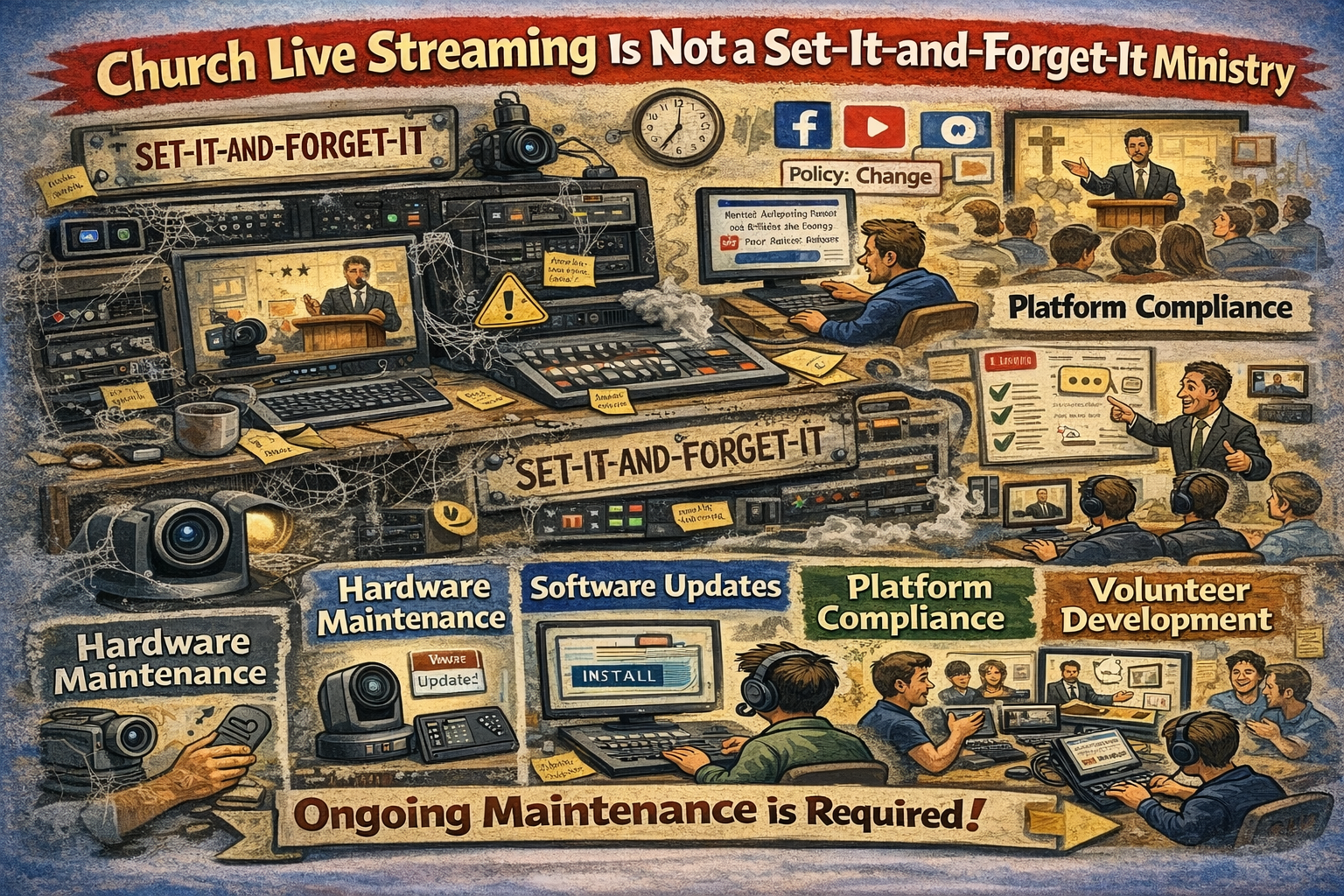
Church live streaming maintenance refers to the continuous operational tasks required to sustain a functional, high-quality broadcast ministry after the initial equipment installation and configuration. These tasks include firmware updates, software patches, volunteer training, equipment lifecycle management, platform compliance monitoring, content strategy adaptation, and real-time quality assurance. The misconception that streaming infrastructure operates indefinitely without intervention leads to degraded broadcast quality, stream failures, and eventual ministry abandonment.
Classification of Maintenance Domains
Ongoing church streaming maintenance falls into six primary categories: hardware maintenance, software and firmware management, platform compliance, volunteer workforce development, content and production strategy, and quality monitoring. Each category operates on its own cycle and demands distinct competencies. Neglect in any single domain can cause cascading failures that affect the entire streaming operation.
Hardware Maintenance and Equipment Lifecycle
Camera Systems
Professional PTZ cameras used in church streaming environments have an operational life expectancy of five to seven years under typical weekly service conditions. Degradation occurs gradually across image sensors, pan-tilt motor assemblies, and optical lens elements. Technology advancement cycles — such as the industry transition from 1080p to 4K resolution, the adoption of NDI protocol, and the introduction of AI-powered auto-tracking — create functional obsolescence before physical failure occurs in many cases.
Churches operating multi-camera systems, such as a 3-camera live streaming kit, must budget for staggered replacement rather than simultaneous full-system upgrades. Staggered replacement distributes cost over multiple budget years and avoids a complete production capability gap during transition.
Streaming Computers and Encoding Hardware
Streaming computers require hardware refresh cycles of three to five years as encoding software demands increase. The shift from H.264 to HEVC (H.265) encoding, emerging AV1 codec support, and increasing baseline resolution expectations all accelerate hardware obsolescence. Operating system end-of-life dates — such as the termination of Windows 10 support in October 2025 — force hardware upgrade decisions independent of physical equipment condition.
A premium streaming computer built with upgrade-compatible architecture extends its useful life through incremental component replacement. RAM, GPU, and storage upgrades can defer full system replacement by one to two years in many configurations.
Cable Infrastructure and Power Systems
HDMI and SDI cables degrade over time, particularly in permanent installations with tight bend radii, foot traffic exposure, or significant temperature variation. Network switches and routers used in NDI-based camera workflows require firmware updates and eventual replacement as network protocol standards advance. Uninterruptible power supply (UPS) batteries require replacement every three to five years regardless of apparent functionality. A UPS battery that has exceeded its cycle life may fail under load during a live broadcast without prior warning.
Firmware and Software Update Management
Camera Firmware
PTZOptics releases firmware updates two to four times annually for its Move 4K and Move SE camera lines. These updates address autofocus algorithm improvements, NDI protocol compatibility, color science refinements, and network security patches (PTZOptics Support, 2024). Blackmagic Design bundles ATEM switcher firmware with ATEM Software Control releases, typically issuing three to five updates per year. Canon issues firmware updates for its CR-N series PTZ cameras addressing auto-tracking accuracy, network security, and protocol support.
Failure to apply firmware updates can result in degraded autofocus performance, incompatibility with updated streaming platform ingest protocols, and unpatched security vulnerabilities on networked devices. Churches operating PTZ cameras with network connectivity, such as the PTZOptics Move 4K 30X, face particular exposure to security risks when firmware is not maintained, as these devices are IP-addressable endpoints on the church network.
Streaming Software
OBS Studio, the most widely used free streaming application, releases major updates quarterly and minor patches more frequently. Version changes can alter plugin compatibility, encoding parameter defaults, and streaming protocol support. Commercial alternatives — vMix, Ecamm Live, Wirecast — operate on similar update cadences. Streaming software that is not kept current may fail to connect to updated platform ingest endpoints or may lose access to critical encoding features.
Maintenance Scheduling
Effective firmware and software update management requires a defined maintenance window, typically scheduled midweek, with post-update testing before the next live broadcast. Updates applied immediately before a live service introduce unacceptable risk of unexpected behavior changes or compatibility failures.
Platform Compliance and Protocol Changes
YouTube Live
YouTube has modified its Live Streaming API multiple times since 2020. Changes include updated RTMP ingest server URLs, modified bitrate recommendations, and adjustments to stream key management workflows. In 2023, YouTube deprecated unencrypted RTMP connections in favor of RTMPS (encrypted RTMP) for all live streams. Churches using older hardware encoders without RTMPS support experienced stream failures until equipment was updated or replaced. YouTube’s recommended encoding bitrate for 1080p60 content increased from 4,500 Kbps to 6,000 Kbps as viewer quality expectations rose (YouTube Creator Blog, 2024).
Facebook Live
Facebook has changed its Live API requirements multiple times, including modifications to persistent stream keys, simulcasting permissions, and group streaming policies. In 2024, Facebook restructured its Live Producer interface, altering the workflow for scheduled streams and multi-destination broadcasting (Meta for Business, 2024). Churches relying on previously saved streaming configurations found those configurations incompatible with the updated interface.
Multi-Platform Considerations
Churches streaming to multiple platforms simultaneously must track policy and technical changes across each destination independently. A protocol change on one platform does not necessarily coincide with changes on others. Multi-destination streaming services such as Restream and StreamYard periodically update their own integration requirements in response to downstream platform changes.
Volunteer Workforce Development
Training as a Continuous Process
Church streaming operations in the United States rely on volunteer labor in approximately 78% of cases (Church Production Magazine, 2023). Initial training for a streaming volunteer requires 8 to 12 hours for basic camera operation and 20 to 40 hours for full production competency encompassing live switching, audio mixing, and graphics overlay management. This initial investment recurs with each new volunteer.
Training does not conclude after initial competency is achieved. Firmware updates alter camera menu structures and control interfaces. Software updates change dashboard layouts and feature availability. Production workflow changes — such as adding a PTZOptics SuperJoy controller for centralized camera management — introduce new operational procedures that all active volunteers must learn.
Volunteer Turnover
The average tenure of a church media volunteer is 18 to 24 months before burnout, schedule conflicts, or other commitments cause departure (Church Answers, 2023). Technical ministry positions experience 30 to 40 percent annual volunteer turnover (The Unstuck Group, 2023). Each departure triggers a full retraining cycle for the replacement volunteer, consuming leadership time and temporarily reducing production consistency.
Churches with single-operator dependencies — situations where one individual holds all institutional knowledge of the streaming system — face the highest risk. Departure of that individual can render the entire streaming operation non-functional until a replacement is trained. Maintaining a minimum of three to four cross-trained operators per weekly service schedule mitigates this risk. Written standard operating procedures reduce retraining time and maintain production consistency across operator rotations.
Content and Production Strategy Evolution
Rising Viewer Expectations
Online worship viewers increasingly expect production quality comparable to professional media broadcasts rather than home-video aesthetics (Barna Group, 2023). Multi-camera productions with graphics overlays, lower-third name identifiers, and pre-produced video elements have transitioned from premium features to baseline expectations. Churches that launched streaming during the COVID-19 pandemic with single static camera setups face growing pressure to upgrade production capabilities as viewer tolerance for minimal production value diminishes.
The transition from a single-camera setup to a multi-camera system, such as an ATEM Mini Pro 2-camera streaming kit, represents a significant operational change. Multi-camera production requires additional trained operators, modified workflow procedures, and updated production planning processes. The equipment upgrade alone does not produce improved results without corresponding investment in human capital and process development.
Platform Algorithm and Discoverability
YouTube’s recommendation algorithm favors consistent upload schedules, strong engagement metrics, and production quality signals. Churches that stream inconsistently or with highly variable quality levels receive reduced algorithmic promotion compared to channels maintaining stable output standards. Thumbnail design, title optimization, and video description metadata require ongoing attention to maintain discoverability. These content strategy tasks fall outside the technical operation of streaming equipment and represent a separate, continuous workload.
Quality Monitoring and Assurance
Pre-Broadcast Verification
Every live broadcast requires pre-service verification of audio levels, video exposure, white balance settings, camera framing, graphics template accuracy, and stream encoder connectivity. These checks cannot be automated in most church streaming configurations and depend on a trained operator arriving with sufficient lead time before the service begins.
Real-Time Stream Health Monitoring
Stream health metrics — including bitrate stability, frame drop rates, encoding latency, and platform ingest confirmation — require active monitoring throughout each broadcast. Internet bandwidth performance should be tested regularly, as ISP throughput can fluctuate due to network congestion, infrastructure maintenance, or service tier changes. A stream that functioned without issue for months can fail without warning if upstream network conditions change.
Post-Broadcast Review
Regular review of archived stream recordings identifies recurring technical issues that may not be visible to the operator during live production. Audio feedback, color temperature drift, autofocus hunting, and frame composition errors often become apparent only upon review. Online viewer analytics — concurrent viewer counts, average watch duration, and chat engagement rates — provide quantitative feedback that informs production improvement decisions.
Budgeting for Ongoing Operations
Church streaming ministries require annual operational budgets that account for software subscriptions, equipment replacement reserves, cable and accessory replacement, internet service costs, and volunteer training materials. The initial equipment purchase represents the largest single expenditure, but cumulative annual operating costs over a five-year period can approach or exceed the original hardware investment. Churches that budget only for initial acquisition and treat streaming as a zero-cost operation after installation consistently experience quality degradation and eventual system failure.
Summary
Church live streaming is an active, operator-dependent ministry that requires continuous investment in hardware maintenance, software updates, platform compliance monitoring, volunteer development, content strategy, and quality assurance. The initial equipment purchase and installation represent the beginning of an ongoing operational commitment, not the completion of a one-time project. Churches that allocate resources exclusively to acquisition without planning for sustained operational support experience predictable declines in broadcast quality, volunteer capacity, and viewer engagement. Effective streaming ministries treat the discipline as a living production operation requiring the same institutional attention as any other weekly ministry program.