
Blog
How much does an ATEM Mini Pro church streaming setup cost

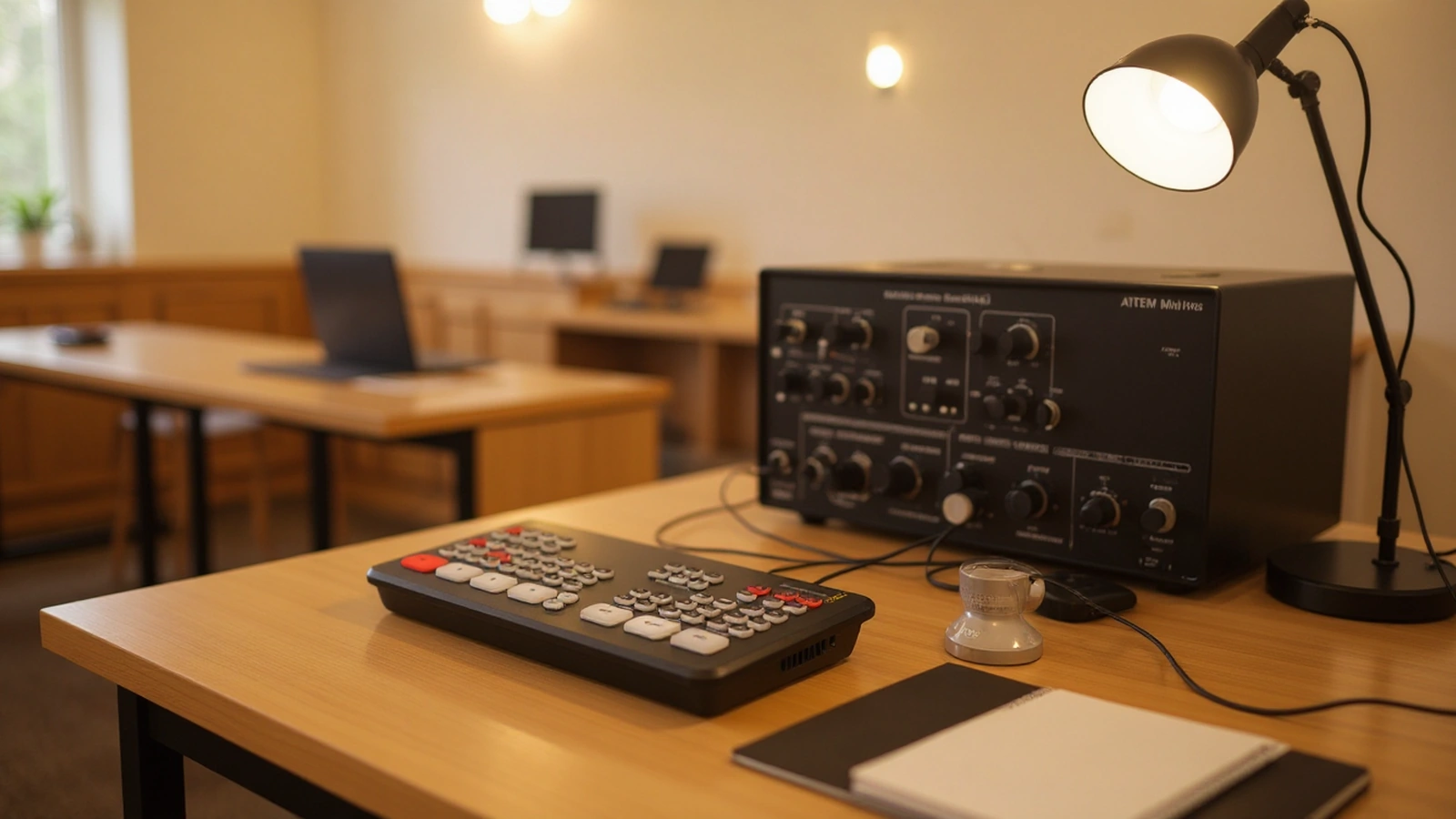
When a church asks us what an ATEM Mini Pro streaming setup actually costs, the honest answer is that the switcher itself is the small part of the bill. The ATEM Mini Pro sells for somewhere in the low-to-mid three hundreds depending on the retailer and the week, so the question you are really asking is what a complete, working Sunday system costs once you add cameras, audio, cabling, and the little parts that nobody mentions until you are standing in the booth without them.
We build these systems for churches every week, so this post walks through the real cost in the order the money actually shows up. We will start with the switcher, move to the cameras that drive most of the budget, then audio, cabling, and the small extras, and finish with the kit prices we see most often so you can match a number to your room.
What the ATEM Mini Pro itself costs and what you get for it
The ATEM Mini Pro is the inexpensive part of the system, usually landing in the range of roughly three hundred dollars give or take, and it does a remarkable amount for that money. It gives you four HDMI inputs, a built-in hardware streaming engine that goes straight to YouTube, Facebook, or a custom destination over an Ethernet cable, recording to a USB drive, a USB webcam output for Zoom, and a built-in audio mixer with transitions and a chroma keyer. Because that streaming engine lives inside the box, you do not need a powerful computer running encoding software just to get a clean signal online.
That single price tag is also why the switcher rarely decides your budget. Four HDMI inputs is plenty for most churches, and the box quietly handles the streaming work that would otherwise demand a capable PC. The cost conversation moves almost immediately to the cameras, because that is where the dollars concentrate.
Cameras are where most of the budget lives
Cameras typically account for more of an ATEM Mini Pro system than every other component combined, and the spread is wide. A single workhorse PTZ camera in a starter kit can sit in the high hundreds, while a higher-end 4K PTZ camera with auto-tracking and a long zoom can run well past a thousand dollars on its own. Multiply that by the number of angles you want and you can see why two churches with the same switcher can be a few thousand dollars apart.
The honest driver here is not megapixels, it is how the camera behaves in your room. A sanctuary is usually dimmer than it looks to the eye, so a camera’s low-light performance and sensor quality tend to matter more than a headline resolution number. The Move-SE 1-camera kit with the ATEM Mini Pro pairs a Sony-sensor PTZ camera with the switcher and lands as our most popular starting point precisely because it gives a clean image without a heavy price.
Zoom range is the other thing that quietly moves the price. The PTZOptics Move-SE comes in 12x, 20x, and 30x versions, and the right one is tied to how far the camera sits from the platform rather than to bigger always being better. A camera mounted at the back of a long sanctuary needs more reach to frame a tight shot of the pastor, while a 12x is plenty in a smaller room. If you want to understand camera selection on its own terms before you commit, our guide to the best PTZ camera for church walks through that decision in depth.
How many cameras you need, and what each one adds
Camera count is the single biggest lever on the total, so it deserves a clear-eyed look rather than a guess. One camera streams a complete, dignified service and is the right answer for a great many churches, especially a plant or a room where the action stays mostly on one platform. The reason to add a second is movement: a wide shot of the room plus a tighter shot of the speaker lets you cut between angles so the stream feels alive instead of static.
A two-camera system tends to fit better when you regularly have a worship band spread across the stage, or when you want to hold a wide while pushing in on a soloist or the person preaching. The Move-SE 2-camera kit with the ATEM Mini Pro is the natural step up, and because PTZ cameras hold presets, one volunteer can run both angles from a single seat instead of needing an operator per camera.
Three cameras suit a larger platform or a church that wants a balcony or side angle in the rotation, and the Move-SE 3-camera kit with the ATEM Mini Pro uses all but one of the switcher’s four inputs while leaving room for a presentation feed. Beyond that you are usually into ATEM Mini Extreme territory for the extra inputs and outputs, which is a different cost conversation. Once you have settled on a count, our overview of the best ATEM Mini Pro live stream setup for churches shows how the pieces fit together at each level.
Audio is the part churches under-budget
The most common regret we hear is not about a camera, it is about sound, because a congregation will forgive a soft image far sooner than muddy or distant audio. The cheapest way to get good audio into the ATEM Mini Pro is to take a feed from the sound board you already use for the room, usually through an HDMI camera feed or a direct line into the switcher’s audio inputs, which means your online audio can be as good as what fills the sanctuary.
If you do not have a board with a clean output to spare, a small dedicated mixer or an audio interface adds somewhere from a couple hundred dollars upward, and it is money well spent. The ATEM Mini Pro has a capable built-in mixer for balancing camera mics against that board feed, so the goal is simply to get one good, intentional signal into the box rather than letting a camera microphone pick up the room from forty feet away. If your stream sound has ever frustrated you, our breakdown of why live stream audio sounds bad and how to fix it is worth reading before you spend a dollar on gear.
The small parts that decide whether Sunday works
Cabling and accessories rarely make it into a budget estimate, and they are exactly what turns a pile of boxes into a working system. Most ATEM Mini Pro setups need HDMI runs from each camera to the switcher, and once a camera sits more than fifteen feet away you are usually into HDMI-over-Cat extenders, where a transmitter near the camera sends signal down an ethernet cable to a receiver near the switcher. Those extenders, the network cable, and a network switch for IP camera control add up to a few hundred dollars across a multi-camera room.
Then there are the easy-to-forget items: tripods or wall mounts for the cameras, a USB drive fast enough to record cleanly, a reliable wired internet connection to the switcher, and a small monitor so your operator can see the program feed. None of these are expensive on their own, but leaving them out is how a church ends up making a second order the week before launch. When we build a kit, we include the parts the workflow actually needs rather than a generic bundle, which is the difference between a system and a shopping cart.
Putting a real number on it
For a single-camera ATEM Mini Pro system with a quality PTZ camera, a clean audio feed, and the cabling to make it work, most churches land somewhere in the low thousands. Adding a second camera and the extenders to support it typically pushes the total up by a meaningful margin, and a three-camera build climbs from there. These are ranges rather than fixed prices, because the camera you choose, the zoom range your room needs, and how far your cameras sit from the switcher all move the figure.
It helps to compare those numbers against the alternative. A local integrator quoting a full-service installation often assumes labor, markup, and on-site service that a volunteer-run church does not always need, which is part of why their quotes can run several times higher. When a church is willing to handle its own mounting and cabling, the difference can be substantial, and we are glad to help choose compatible parts so nothing in the system fights anything else. Our look at the real cost of not live streaming your services frames the other side of the ledger, which is what staying offline quietly costs a congregation.
Choosing the kit that fits your room and budget
The cleanest way to land on a real number is to start from your room and your people rather than from a spec sheet. A church of thirty in a single bright room with one platform is well served by one camera and a clean board feed, while a growing church with a wide stage and a balcony will be happier with two or three angles a volunteer can pre-set and cut between. Both build on the same affordable switcher, so the budget question is mostly about how many cameras the room genuinely needs.
If you want a sensible place to begin, the Move-SE 1-camera kit with the ATEM Mini Pro gives you a complete, reliable system at the lower end of the range, and stepping up to the Move-SE 2-camera kit with the ATEM Mini Pro adds the movement that makes a stream feel produced. Tell us your room size, how far the cameras will sit from the platform, and where your audio comes from, and we will help you match the kit and the price to what Sunday actually requires.