
The Real Cost of Not Live Streaming Your Church Services

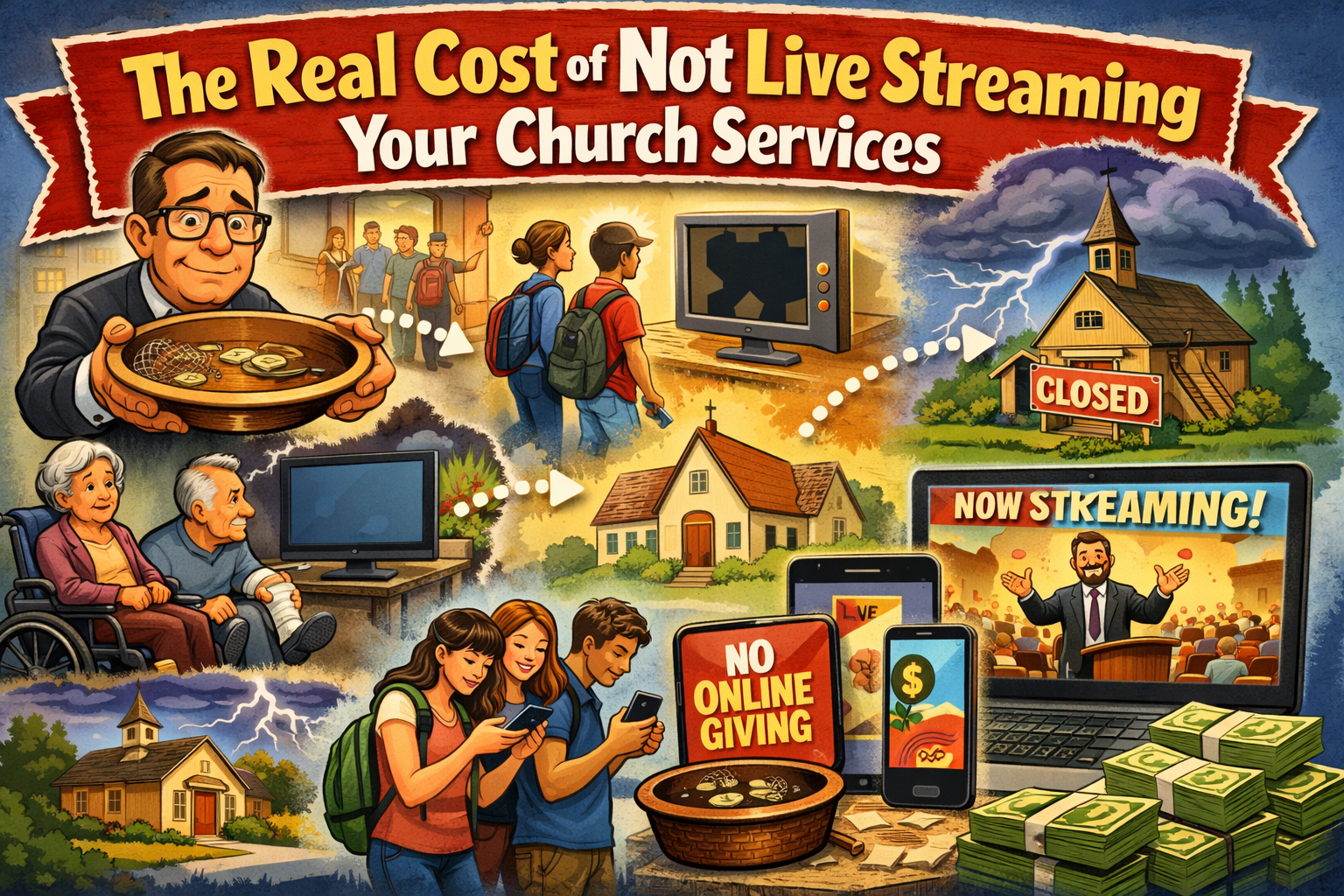
Opportunity cost, in the context of church live streaming, refers to the measurable and unmeasurable losses a congregation incurs by not broadcasting services online. These losses include unreached prospective visitors, disconnected homebound members, reduced giving, diminished visibility among younger demographics, and vulnerability to service disruptions. As of 2023, 66% of Protestant churches in the United States stream their worship services (LifeWay Research, 2023). The remaining 34% operate without a digital worship presence.
The costs described below are not theoretical. Each category is supported by survey data from recognized research organizations including LifeWay Research, Barna Group, Pew Research Center, ACS Technologies, and Pushpay.
Lost Prospective Visitors
First-time church visitors increasingly rely on digital research before attending in person. LifeWay Research reported in 2023 that 77% of first-time church visitors researched a church online before attending. Of those, 54% stated that watching a recorded or live service online influenced their decision to visit (LifeWay Research, 2023).
Churches that do not stream provide no video content for this evaluation process. A prospective visitor comparing two churches — one with an accessible live stream archive and one with no video presence — lacks critical information about the non-streaming church’s worship style, preaching, and congregational environment. Grey Matter Research found in 2022 that 63% of churchgoers said the quality of online content influenced their perception of a church’s professionalism and credibility (Grey Matter Research, 2022).
ACS Technologies reported in its 2022 Church Technology Survey that churches with consistent, high-quality streams experienced first-time visitor increases of 10-15%. The same study found that 74% of churches using streaming technology saw attendance stabilize or increase within 18 months of launching a stream (ACS Technologies, 2022). Non-streaming churches forgo these visitor acquisition gains entirely.
Disconnected Homebound and Disabled Members
Pew Research Center reported in January 2024 that 16% of U.S. adults who attend religious services do so primarily online. Among online-only attendees, 36% cited health problems or disabilities as a reason for not attending in person (Pew Research Center, 2024).
The U.S. Census Bureau reported in 2023 that approximately 13.4% of the civilian noninstitutionalized population has a disability. Among adults aged 65 and older, this figure rises to approximately 40% (U.S. Census Bureau, 2023). Churches with aging congregations face a growing segment of members unable to attend due to mobility limitations, chronic illness, post-surgical recovery, or residence in assisted living facilities.
Without live streaming, these individuals have no means of participating in worship services. Non-streaming churches effectively exclude a portion of their existing membership from weekly congregational life. An entry-level budget church live streaming kit provides the minimum hardware necessary to establish a digital connection with homebound members.
Reduced Visibility Among Younger Demographics
Adults under 40 evaluate institutions primarily through digital channels. Barna Group reported in 2024 that 57% of practicing Christians attended church services online at least once per month (Barna Group, 2024). Among Millennials and Gen Z churchgoers, digital presence functions as a baseline expectation rather than a differentiator.
Pew Research Center data from 2022 indicates that younger cohorts (ages 18-34) demonstrate higher rates of digital-first church discovery than older cohorts (Pew Research Center, 2022). Religious disaffiliation is also highest among these age groups. Churches without a streaming presence are invisible to a generation that discovers and evaluates organizations through video content, social media, and search engines.
The absence of streaming eliminates a church from the digital discovery process entirely. A congregation that does not appear in YouTube search results, Facebook Live listings, or church directory platforms with embedded video has no mechanism for reaching adults under 40 who have not already been introduced through personal relationships.
Financial Impact: Giving and Engagement
Pushpay’s 2023 “Church Engagement Trends” report found that churches offering online streaming saw 12% higher overall engagement — including giving, small group participation, and volunteering — compared to churches that did not stream (Pushpay, 2023). Online-only viewers gave at lower rates than in-person attendees, but their contributions represented incremental revenue that churches would not have received without a streaming option.
Live streaming creates a real-time giving prompt for remote participants. Viewers watching a service through YouTube, Facebook, or a church app encounter embedded giving links, on-screen calls to donate, and platform-integrated donation tools. Without a stream, churches lack this digital giving mechanism for travelers, irregular attendees, and members who miss a given Sunday.
The financial opportunity cost compounds over time. A church of 200 regular attendees with 30-50 additional online viewers per week — a common ratio reported by ACS Technologies (2022) — forfeits the cumulative giving potential of those remote viewers every week the stream is absent.
Competitive Position Among Other Churches
The two-thirds of Protestant churches that stream represent the current market baseline (LifeWay Research, 2023). Non-streaming churches are positioned in a shrinking minority. Hartford Institute for Religion Research reported in 2023 that congregations with high-quality streaming programs recovered in-person attendance faster than congregations without streaming (Hartford Institute, 2023).
A prospective visitor evaluating multiple churches in a geographic area will encounter some congregations with full video archives, live Sunday broadcasts, and social media clip libraries. Non-streaming churches offer no comparable digital presence. This disparity places non-streaming congregations at a measurable disadvantage in attracting new members.
Barna Group reported in its 2024 “State of the Church” data that only 23% of churches that stream have a dedicated strategy for engaging online attendees (Barna Group, 2024). This indicates that even basic streaming — without advanced engagement features — establishes a competitive digital presence that non-streaming churches lack entirely.
Vulnerability to Service Disruptions
Churches without streaming infrastructure have no contingency for maintaining congregational engagement during facility closures. Pew Research Center reported in March 2021 that 40% of U.S. adults who typically attended religious services at least monthly watched services online during the COVID-19 pandemic (Pew Research Center, 2021).
Churches without streaming infrastructure during the 2020 pandemic experienced average attendance declines of 30-50% with no digital fallback (Barna Group, 2021). Congregations with established streaming systems maintained worship continuity within hours of facility closures. Weather events, building maintenance emergencies, and localized public health situations create recurring disruption risks that extend beyond pandemics.
A non-streaming church faces a binary outcome during any facility closure: total cessation of services or improvised low-quality broadcast using personal devices. Churches with dedicated streaming hardware — such as an ATEM Mini Pro 1-camera streaming kit — can transition to remote broadcasting with minimal preparation. A 1-camera live streaming starter kit provides a pre-configured system that reduces setup time and technical complexity during emergency situations.
Quantified Summary of Opportunity Costs
The following table consolidates the measurable costs identified across multiple research sources:
| Opportunity Cost Category | Quantified Impact | Source |
|---|---|---|
| Lost visitor evaluation pathway | 77% of first-time visitors research online; 54% influenced by video | LifeWay Research, 2023 |
| Excluded homebound members | 16% of religious service attendees are primarily online; 36% cite disability | Pew Research Center, 2024 |
| Missed younger demographic reach | 57% of practicing Christians watch online monthly | Barna Group, 2024 |
| Lower engagement and giving | 12% lower overall engagement at non-streaming churches | Pushpay, 2023 |
| Competitive disadvantage | 66% of Protestant churches stream; non-streaming is minority position | LifeWay Research, 2023 |
| Disruption vulnerability | 30-50% attendance decline during closures without streaming | Barna Group, 2021 |
| Forgone visitor growth | 10-15% first-time visitor increase attributed to quality streaming | ACS Technologies, 2022 |
Equipment and Implementation Considerations
The barrier to entry for church live streaming has decreased substantially since 2020. Pre-configured streaming kits eliminate the need for individual component selection and technical assembly. A single-camera system with virtual multi-angle capability requires one trained volunteer to operate.
Budget-tier systems start below $1,500 and include a camera, encoding hardware, and necessary cabling. Mid-range configurations such as a Yolobox live streaming kit consolidate switching, encoding, recording, and monitoring into a single portable device. Multi-camera systems provide angle variety that improves viewer retention and production quality. A 2-camera live streaming kit enables distinct speaker and wide-angle shots for small-to-medium worship spaces.
Churches requiring a dedicated streaming processor can pair camera systems with a premium streaming computer designed for single-camera encoding workflows. Minimum internet requirements for 1080p streaming are 5-10 Mbps sustained upload speed over a wired Ethernet connection (FCC Broadband Deployment Report, 2023).
Classification of Non-Streaming Risk Factors
Non-streaming churches face the following categorized risks:
- Visitor acquisition deficit. Inability to provide video content for the 77% of prospective visitors who research churches online.
- Member retention gap. Homebound, disabled, traveling, and relocated members lose access to weekly worship participation.
- Demographic irrelevance. Absence from digital channels used by adults under 40 for institutional discovery and evaluation.
- Revenue leakage. Loss of incremental giving from remote viewers and digitally engaged members.
- Competitive erosion. Increasing visibility gap relative to the 66% of churches that stream.
- Operational fragility. No service continuity mechanism during facility closures or disruptions.
Each risk factor operates independently and compounds over time. The cumulative effect is a measurable reduction in congregational reach, engagement, and financial sustainability.